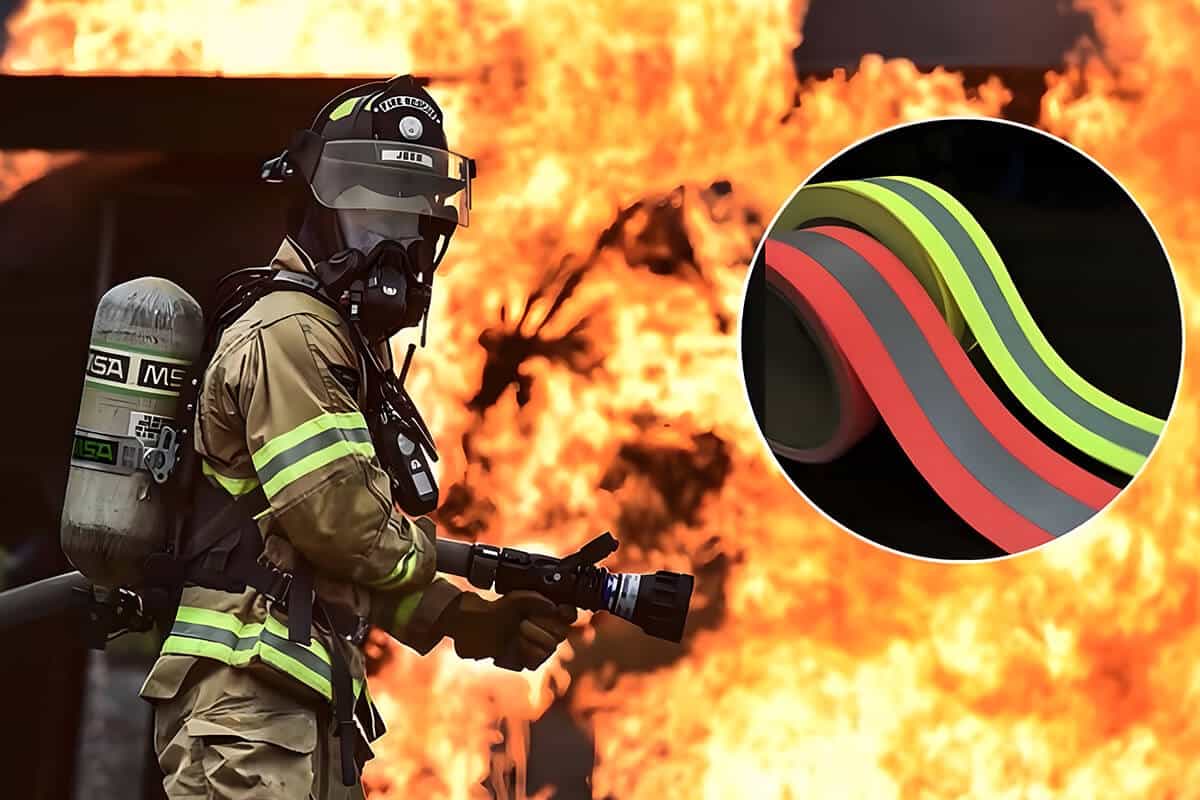
In occupational safety and Personal Protective Equipment (PPE) sourcing, evaluating retroreflective materials based solely on visual impressions is a dangerous practice. Under office lighting or a smartphone camera flash, almost any freshly coated reflective trim looks brilliant. Yet in real-world operating environments—where materials are subjected to mechanical abrasion, engine oil spills, sub-zero flexing, monsoon rainfall, and aggressive commercial laundries—untested materials experience rapid, catastrophic photometric failure.
For safety directors and procurement teams, retroreflective performance cannot be treated as an aesthetic feature. It is a legally regulated life-safety specification governed by stringent international standards, including EN ISO 20471 (Europe), ANSI/ISEA 107 (North America), AS/NZS 1906.4 (Australia/NZ), and GB 20653 (China).
True quality in reflective materials is not defined by how bright a swatch looks in a showroom; it is defined by how much optical performance remains after the material has been subjected to a gauntlet of laboratory environmental torture tests.
Photometric optics: understanding coefficient of retroreflection (Ra)
The universal metric of reflective performance is the Coefficient of Retroreflection, denoted as Ra (or R'), expressed in candelas per lux per square meter:
Unit of retroreflection: cd/(lx·m²)
This coefficient quantifies the luminous intensity (candelas) returned to the observer's eyes per unit of illuminance (lux) falling upon the reflective surface (square meters).
The optical measurement geometry
Retroreflection is not omnidirectional; it is a focused cone of return light. Photometric methods such as ASTM E810 specify how measurements are made, while the applicable product standard determines the required geometries and acceptance table: See ASTM E810 measurement-method scope.
- Observation Angle (α): The angular separation between the illumination beam (vehicle headlights) and the observation axis (driver's line of sight). Common reported geometries include α = 0.2° (12 arcminutes) and approximately α = 0.33° (20 arcminutes). Their relationship to a 100–150 meter viewing example depends on the actual headlamp-to-eye separation; these angles are not unique vehicle-type classifications.
- Entrance Angle (β₁): The angle at which the light strikes the garment surface relative to the surface normal. Testing evaluates wide-angle performance at β₁ = 5°, 20°, 30°, and 40°.
Photometric thresholds and material scope
For the EN ISO 20471 separate-performance retroreflective material example below, values must be tied to the stated measuring geometry. Combined-performance material has different requirements; ANSI/ISEA 107 must be checked against its own applicable edition and tables. A material Ra result does not establish the finished garment class. See ISO 20471 material and garment requirements.

- Brand New (As-Received) State: The separate-performance material example uses an initial baseline of Rₐ ≥ 330 cd/(lx·m²) at α = 0.2°, β₁ = 5°. Premium commercial grades typically deliver 450 to 550 cd/(lx·m²) to provide safety margin against in-service wear.
- Post-Conditioning (Degraded) State: A residual value of Rₐ ≥ 100 cd/(lx·m²) is used in the separate-performance example at the specified head-on geometry after relevant exposures. Do not apply this value to every material type or test; check the complete acceptance table and specimen orientation.
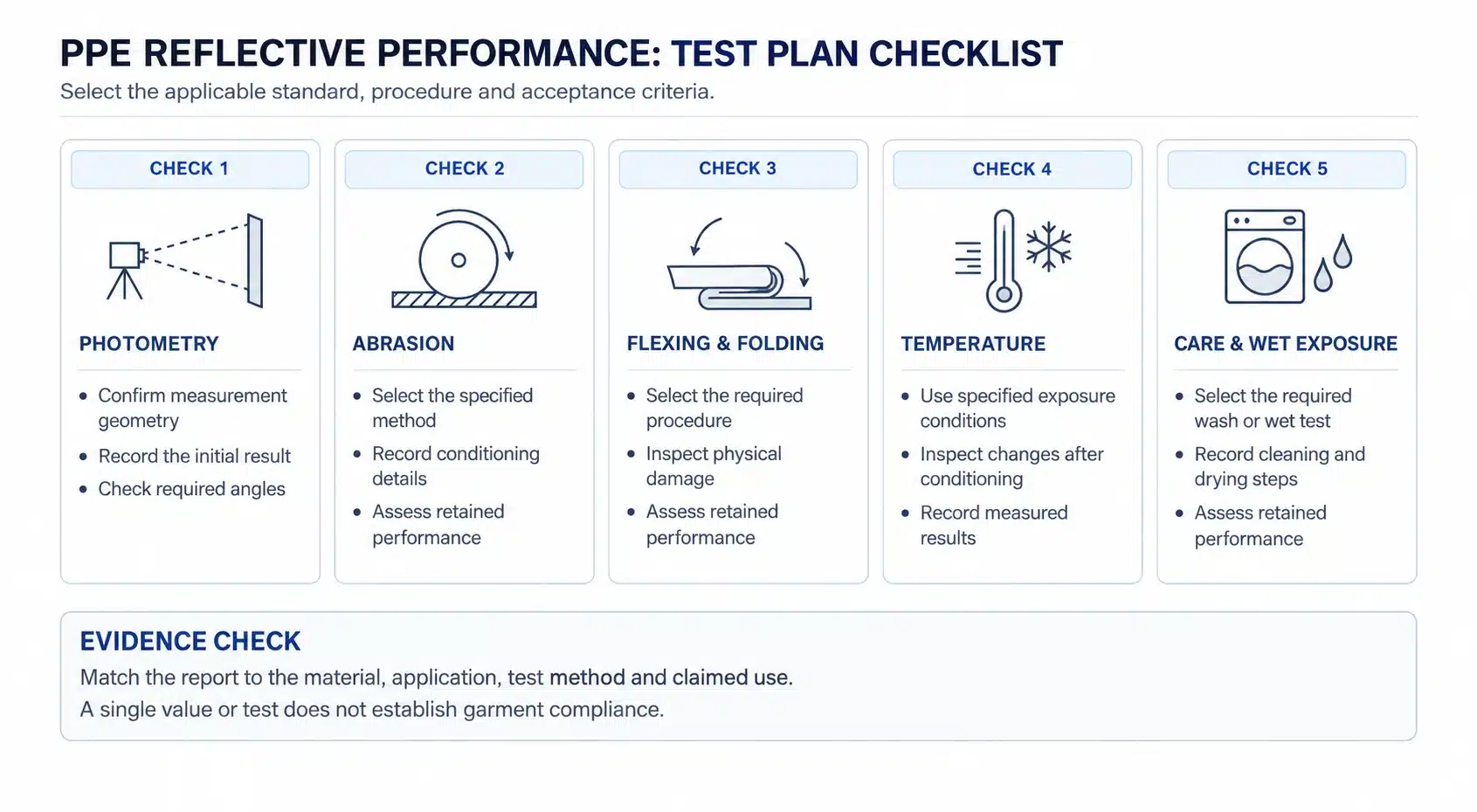
Five laboratory conditioning checks to specify
The following five checks organize the supplied technical brief. They are not a complete or universal certification programme. The exact standard edition, material category, specimen preparation, test settings and acceptance criteria must be agreed with the laboratory. Numeric process settings below are retained from the supplied brief and require confirmation where the cited public source does not provide the full normative procedure.
Test 1: Martindale mechanical abrasion (EN 530 method 2)
- Protocol in the technical brief (confirm with the laboratory): The reflective surface is mounted in a Martindale abrasion tester under a continuous downward contact pressure of 9 kPa. It is rubbed against a standard cross-bred worsted wool abradant cloth through a multi-directional Lissajous figure for 5,000 continuous cycles.
- Failure Mode: Low-grade trims suffer binder breakdown; the glass beads scrape off like sand, leaving dull, bare backing fabric.
- Proposed acceptance check (confirm the applicable requirement): The abraded area must exhibit zero surface breakthrough, with residual Rₐ ≥ 100 cd/(lx·m²).
Test 2: dynamic flexing fatigue (ISO 7854 method A)
- Protocol in the technical brief (confirm with the laboratory): The material is clamped between two reciprocating cylindrical grips in a De Mattia flexing machine and subjected to 7,500 rapid flex cycles.
- Failure Mode: Brittle polymer formulations develop micro-cracking, crazing, or delamination between the glass-bead resin and the backing fabric.
- Proposed acceptance check (confirm the applicable requirement): No visible micro-cracking or delamination; residual Rₐ ≥ 100 cd/(lx·m²).
Test 3: sub-zero cold fold resistance (ISO 4675)
- Protocol in the technical brief (confirm with the laboratory): Samples are conditioned inside a climatic chamber at -20°C for 4 hours, immediately folded double inside the chamber, and struck with a calibrated 2 kg impact mass.
- Failure Mode: Materials reaching their glass transition temperature (such as standard plasticized PVC) suffer brittle through-cracking.
- Proposed acceptance check (confirm the applicable requirement): Zero surface cracking, peeling, or loss of adhesion.
Test 4: extreme thermal cycling shock
- Protocol in the technical brief (confirm with the laboratory): The material is placed in a dry oven at +50°C for 12 hours, immediately transferred to -30°C for 20 hours, and then brought back to ambient room temperature.
- Failure Mode: Thermal expansion differentials between the reflective skin and the textile backing can cause edge curling, adhesive bubbling, or binder blistering.
- Proposed acceptance check (confirm the applicable requirement): Dimensional stability maintained; residual Rₐ ≥ 100 cd/(lx·m²).
Test 5: rainfall influence simulation (wet retroreflection)
- Protocol in the technical brief (confirm with the laboratory): The material is mounted vertically and subjected to a continuous calibrated water spray simulating a torrential downpour (water spray rate of roughly 50 mm/hour). Photometric measurements are recorded while the water is actively spraying.
- Failure Mode: Surface water forms a continuous refractive sheet, scattering incoming light and reducing retroreflection below visibility limits.
- Proposed acceptance check (confirm the applicable requirement): Wet retroreflective coefficient is assessed against the applicable wet-test requirement; Rₐ ≥ 100 cd/(lx·m²) is the supplied separate-performance target, not a universal value for combined-performance materials.
Laundering durability: domestic vs. industrial rental certification
Laundering fatigue is an important cause of reflective trim failure on active workwear. Sourcing teams must distinguish between domestic and industrial test procedures. ISO 6330 and ISO 15797 provide procedure options; neither fixes one universal temperature, detergent chemistry, drying process or cycle count. The values below describe the supplied application examples, and the selected procedure and finishing method must be stated separately.
| Parameter | Domestic home laundering example | Industrial commercial laundry example |
|---|---|---|
| Test-method family | ISO 6330 | ISO 15797 |
| Wash temperature | 60°C | 75°C to 85°C |
| Detergent / chemistry in the brief | Neutral ECE reference detergent; pH 7.0–8.0 | Heavy alkaline commercial wash liquor; pH 11.5–12.5 |
| Bleaching in the brief | Not specified | Peracetic acid or hydrogen peroxide wash stages |
| Drying / finishing in the brief | Low-heat tumble dry or line dry | 160°C tunnel finisher / drying carousel under high mechanical air velocity |
| Specified target | 25–50 cycles | 50 cycles with zero delamination |
Technical Note on Certification Scope: An accredited test certificate stating "Complies with EN ISO 20471 after 50 washes" cannot support an industrial-laundry claim unless the report identifies the exact wash test method, finishing method and number of cycles. A result under ISO 6330 does not establish compatibility with the intended industrial process; additional validation may be needed.
Auditing supplier test certificates: 5 critical red flags
When evaluating supplier test reports from accredited bodies (such as SATRA, TÜV Rheinland, UL, BTTG, or Calcoast), look for these common compliance gaps:

- The "Loose Tape vs. Garment Composite" Disconnect:
- Suppliers frequently submit raw, unapplied reflective tape to test houses. However, when the trim is applied to the final garment shell via heat press or sewing, the shell fabric's dyes, finishing oils, or stretch characteristics can alter the result. Insist on reports that evaluate the trim applied to the actual production shell fabric.
- Report currency and certificate validity:
- A test report has no universal three-year expiry rule. Check whether its material identity, formulation, applicable standard edition and production controls remain current. For EU PPE, the EU type-examination certificate is a separate document with a validity period of no more than five years, with review required for relevant changes or before expiry; UK requirements must be assessed separately. See EU PPE Regulation, Annex V.
- Missing Chromaticity Coordinates for Fluorescent Trim:
- For fluorescent background or genuinely combined-performance materials (a fluorescent-yellow/silver assembly is not automatically a combined-performance material), the test report must certify both retroreflection (Ra) AND daytime color coordinates (x,y) alongside luminance factor (β) both before and after accelerated xenon arc weathering.
- Mismatched Batch Number Traceability:
- Ensure the commercial invoice and carton labels match the specific product code and lot designation listed in the accredited test report. A certificate issued for product "MX-200" does not validate "MX-200-Economy".
- Partial Standard Testing (Selective Omissions):
- Scrutinize the report table of contents. Some low-cost suppliers commission test houses to execute only the initial dry photometric test, omitting the costly Martindale abrasion, cold fold, and rainfall conditioning gates.
Evaluate Reflective Performance for PPE: Technical Audit Checklist
The numeric values below are supplied purchaser targets and review prompts. Apply the acceptance limits, measuring geometry, material category and complete conditioning sequence required by the selected standard and contract; they are not a substitute for that assessment.
| Audit checkpoint | Verification method | Purchaser target / evidence to confirm | Potential consequence if unsuitable |
|---|---|---|---|
| Baseline Retroreflection | Calibrated retroreflectometer (5-point incoming-check example; report angles) | Rₐ ≥ 450 cd/(lx·m²) | Investigate against the agreed purchase specification |
| Post-Abrasion Retention | Review accredited lab report (EN 530) | Rₐ ≥ 100 cd/(lx·m²) after 5,000 cycles | Rapid wearing off on job sites |
| Industrial Wash Rating | Audit test method (ISO 15797 @ 75°C) | Report the selected procedure and 50-cycle target with specified tunnel finishing | Peeling/blistering in commercial laundry |
| Cold Flexibility | Verify ISO 4675 cold fold test (-20°C) | Zero surface cracking or crazing | Shattering in sub-zero winter work |
| Rainfall Performance | Verify wet retroreflection test | Wet Rₐ ≥ 100 cd/(lx·m²) | Reduced wet-weather retroreflection |
| Batch Traceability | Check carton label against mill certificate | Exact matching lot/roll serial numbers | Inability to defend product liability audits |
Frequently asked questions
Can handheld retroreflectometers replace formal laboratory testing?
A handheld reading cannot replace the complete required test programme. Handheld retroreflectometers are useful for incoming quality control (IQC) and factory-floor comparisons. Many are configured for selected angles, such as α = 0.2° and β₁ = 5°; available geometries depend on the instrument. ASTM E810 permits suitable portable or bench equipment when its geometry and reference requirements are met. The instrument reading alone does not carry out abrasion, weathering, laundering or wet conditioning.
Why do some reflective materials fail only after being applied to dyed garment fabrics?
This failure mode is caused by dye sublimation migration. During heat pressing or other elevated-temperature processing, disperse dyes from 100% polyester shells can vaporize and migrate into the polyurethane adhesive and glass-bead binder layers. This dye migration discolors the reflective surface (e.g., turning silver into cloudy pink or yellow), with losses of up to 60% in the supplied manufacturing example; the result depends on the actual construction and exposure. Garments dyed with disperse dyes require reflective trims engineered with anti-sublimation barrier layers.
How often should a PPE brand re-test its reflective materials?
Set a documented, risk-based review plan with the test laboratory and, where applicable, the notified body. The supplied internal QA example uses: 1) a full laboratory review every 3 years; 2) incoming Ra spot checks on every production lot; and 3) an annual 5-cycle garment wash trial. These are proposed buyer controls, not universal statutory intervals. Relevant material or construction changes can trigger earlier reassessment. For EU PPE, track the separate EU type-examination certificate and its review/expiry requirements.
What is the difference between EN ISO 20471 level 1 and level 2 reflective material?
Do not use the older EN 471 Level 1/Level 2 terminology as a substitute for the current material category and photometric table. EN ISO 20471 distinguishes separate-performance retroreflective material from combined-performance material. The familiar Rₐ ≥ 330 cd/(lx·m²) value is a specified new-material geometry for the separate-performance table, not a universal threshold for every reflective trim or a garment Class 1/2/3 rating.


Related blogs
Custom Reflective Accessories RFQ Guide: 8 Technical Specs Suppliers Need Before Quoting
Custom Printed Reflective Tape
Custom Reflective Gear: Sew-On vs. Heat Transfer & The OEM Process
Reflective Piping for Clothing
Related products

Reflective piping

Reflective ribbon tape

PVC Reflective Tape