When sourcing custom reflective trims, receiving a list of follow-up questions instead of a price can delay development schedules.
A brief inquiry such as “Please quote 50mm yellow/silver sew-on reflective tape” appears straightforward, but in reflective manufacturing, it leaves dozens of critical variables open. Two trims that look nearly identical in a photograph can differ by more than 200% in cost—ranging from $0.11/meter for standard decorative piping to over $0.85/meter for industrial-laundry flame-retardant composites.
When suppliers receive incomplete requests, they are typically forced to quote with excessive risk margins or base the price on low-grade specifications that fail subsequent garment testing. To secure accurate, comparable quotes on the first pass, procurement briefs must define specifications across eight key technical areas.
Classify the Product Construction Type
“Reflective accessory” encompasses several distinct manufacturing categories, each utilizing different equipment and costing structures:
- Roll Goods: Reflective fabric tape, webbing, and heat transfer film.
- Formed Edge Trims: Flanged cord piping, flat binding, and mesh piping.
- Fabricated Hardware: High-visibility armbands, sashes, zipper pulls, and badges.
- Specialty Optical Yarns: Single/double-sided reflective thread and knitted ribs.
The Three-Part Composite Structure of Piping
Piping frequently creates sizing confusion. An inquiry stating only “1.5 cm piping” cannot be calculated for production, because standard piping is an assembled three-part composite:
Total Finished Trim = Reflective Face Strip + Flange/Mesh Insertion Tape + Internal Core Cord
- Reflective Face Width: The exposed retroreflective portion visible outside the seam (e.g., 1.3 cm).
- Flange Insertion Width: The non-reflective border captured inside the garment seam (e.g., 2.0 cm white polyester mesh).
- Core Cord Diameter: The internal polypropylene or cotton cord (e.g., 2.0 mm), which dictates presser foot clearance on the sewing line.
Without flange dimensions and cord diameter, suppliers cannot calculate material yield or configure folding guides.
Specify Dimensional Geometry and Engineering Tolerances
In addition to nominal width, briefs must define component breakdown and acceptable slitting tolerances:
| Component / Format | Standard Nominal Width | Technical Slitting Tolerance | Production Impact |
|---|---|---|---|
| Monochrome Silver Tape | 25 mm, 50 mm, 100 mm | ±1.0 mm | Slit directly from jumbo rolls with minimal scrap; most cost-effective. |
| Two-Tone (Yellow-Silver-Yellow) | 50 mm (15-20-15 mm) | Overall ±1.5 mm, silver ±1.0 mm | Requires multi-pass lamination or twin-needle stitching; alignment is critical for auto-cutters. |
| Two-Tone (Yellow + Silver) | 50 mm (25 mm + 25 mm) | ±1.0 mm per side | Split-half lamination; edge guidance prevents thick overlapping seams. |
| Reflective Webbing Tape | 25 mm, 38 mm, 50 mm | ±2.0 mm (yarn weave) | Base webbing has natural shrinkage; specify weight and pre-shrinkage. |
Technical Note on Webbing Weight & Shrinkage: Base webbing weight (GSM) directly drives material cost. Standard workwear webbing is typically 11–12 GSM, while heavy-duty industrial webbing reaches 24+ GSM. Furthermore, webbing must be specified as heat-set and pre-shrunk. Untreated webbing will shrink during garment laundering while the laminated reflective surface remains dimensionally stable, causing severe surface puckering (rippling).
Define the Backing Substrate Chemistry
The backing fabric dictates tensile strength, hand feel, thermal properties, and compatibility with the garment shell:
- 100% Polyester Backing: Economical, lightweight, and crisp. Ideal for promotional vests and low-stress utility apparel.
- TC Backing (65% Polyester / 35% Cotton): The standard workwear choice. Balances high tear strength with dimensional stability across repeat laundering.
- 100% Cotton Twill FR Backing: Engineered for flash-fire risks in petrochemical and utility workwear. Cotton fibers char without melting or dripping onto skin.
- Aramid / Nomex® Synthetic FR Backing: Premium protection for electrical arc flash and high-temperature environments. Material costs are significantly higher than FR cotton.
- Elastic Knitted Backing (Spandex Blend): Essential for performance activewear. Applying rigid polyester trim on stretch seams will cause seam popping or film delamination during movement.
Define Laundering Performance (Domestic vs. Industrial Wash)
Laundering requirements represent the single largest pricing differentiator:
- Domestic Home Wash (ISO 6330): Evaluated at 40°C–60°C with neutral detergents. Conventional reflective tapes range from $0.35–$0.55/meter.
- Industrial Laundry (ISO 15797): Evaluated at 75°C–85°C with high alkalinity (pH 10.5+) and 160°C tunnel finishers. Requires cross-linked thermoset adhesive chemistry, with prices ranging from $0.75–$0.90+/meter.
Technical Note on Cost Impact: A 50mm flame-retardant tape rated for 25 domestic wash cycles (ISO 6330) costs approximately $0.50–$0.55/meter. The equivalent tape engineered for 40–50 industrial wash cycles (ISO 15797) costs $0.80–$0.85/meter—a 60% price differential. Defining the testing standard prevents costly under-specification.
Optical Performance: Certified Safety vs. Decorative Fashion
Retroreflective performance varies substantially depending on the optical structure:
- Certified High-Luminance Silver: Achieves Ra ≥ 330 to 450+ cd/(lx·m²). Complies with EN ISO 20471 Class 2 and ANSI/ISEA 107-2020 Type R.
- Rainbow / Iridescent Reflective Films:
- Exhibits dark gray or oil-slick tones under ambient light, shifting into a multicolored glow under direct beam illumination.
- Rainbow materials typically register retroreflective values of 50–80 cd/(lx·m²), which falls far short of regulatory thresholds (Ra ≥ 330). It is suitable for lifestyle and athletic styling, but cannot be used as primary reflective trim on regulated high-visibility workwear.
Specify the Attachment Method (Heat Transfer vs. Stitching)
The factory application route determines adhesive chemistry and construction details:
Heat Transfer Film (HTV):
- State shell fabric composition (100% cotton, poly/spandex, nylon taffeta, or DWR-treated softshell).
- Fluorocarbon DWR (Durable Water Repellent) coatings cause standard hot-melt adhesives to delaminate after washing. Specify low-surface-energy adhesive formulations if working with water-repellent shells.
Sew-On Trim:
- Indicate edge margins and needle spacing. Heavy industrial needle gauges directly piercing dense glass-bead arrays can fracture optical beads and cause seam fraying.
Assembled Hardware Details (Armbands, Sashes, Badges)
When ordering fabricated finished goods rather than continuous roll goods, component spacing and stitch clearances must be defined:
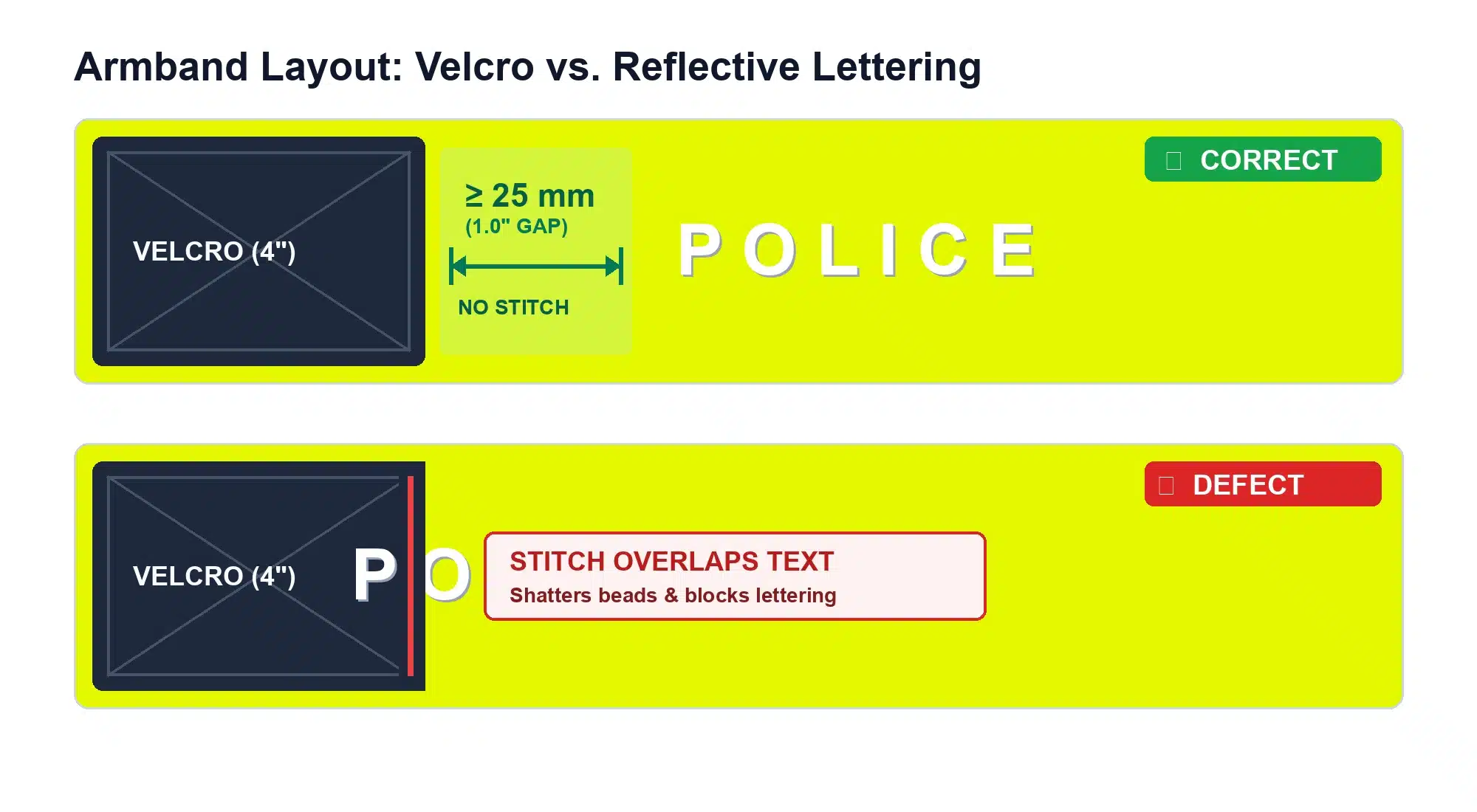
- Fastener Clearance Gap: Define hook and loop dimensions (e.g., 4-inch / 100 mm) and orientation. Technical drawings must explicitly state: “Maintain a minimum 25 mm (1.0 inch) clearance between Velcro box-stitching and reflective lettering.” Without this gap, sewing needles pierce and fracture the retroreflective glass bead matrix, weakening tear strength along the seam and causing government QA rejections due to obscured text.
- Artwork Standards: Supply
.AIor.EPSvector files with Pantone TCX references, specifying whether branding is screen-printed, heat-transferred, or high-frequency debossed.
Commercial Supply Chain Parameters (MOQ, Sampling, Surcharges)
Reflective trim manufacturing is governed by batch and setup constraints:
- Stock Slitting vs. Custom Tooling (MOQ):
- Standard silver tape slit from stock master rolls features lower MOQs (500–1,000 meters).
- Custom multi-component trims (such as custom-dyed mesh piping) require dedicated extrusion and folding runs, with standard MOQs of 3,000–5,000 meters.
- Two-Tier Sampling Protocol:
- Development Swatches (1–5 meters): For initial color, hand feel, and design review.
- Pilot Production Rolls (30–50 meters): Essential for line setup, folder threading, and destructive 25-cycle wash audits.
- Sub-MOQ Handling Fees: Small development runs frequently carry an export/machinery handling fee (typically $50–$100) to offset custom knife resetting and customs documentation overhead.
Standardized B2B Reflective RFQ Specification Sheet
Use this standardized template when preparing inquiries:
RFQ TEMPLATE
Request for Quotation (RFQ): Custom Reflective Component
- Target Application:
- Final Product: [e.g., Highway Safety Vest / Tactical Armband / Running Windbreaker]
- Shell Fabric Composition: [e.g., 100% Poly Tricot / 89% Poly 11% Spandex / DWR Softshell]
- Product Type & Form:
- Category: [Sew-on Tape / Heat Transfer Film / Cord Piping / Fabricated Armband]
- Construction Breakdown: [e.g., Piping: 1.3cm reflective strip x 2.0cm mesh flange x 0.2cm cord]
- Dimensions & Slitting Specs:
- Total Width: [e.g., 50 mm ± 1.5 mm]
- Visual Breakdown: [e.g., 15mm Yellow - 20mm Silver - 15mm Yellow]
- Roll Length / Piece Length: [e.g., 100 meters/roll OR 45 cm finished piece]
- Material & Substrate:
- Backing Type: [100% Polyester / 65/35 TC / 100% Cotton FR / Spandex Knit]
- Base Weight: [e.g., 11-12 GSM, Pre-shrunk]
- Performance & Laundering Requirements:
- Washing Standard: [ISO 6330 60°C x 25 cycles OR ISO 15797 75°C x 50 cycles Industrial Wash]
- Compliance Targets: [EN ISO 20471 Class 2 / ANSI 107-2020 / Non-regulated Fashion Only]
- Minimum Retroreflectivity: [e.g., Ra >= 400 cd/(lx*m2)]
- Commercial & Delivery Scope:
- Sample Requirement: [e.g., 10m swatch for fit test + 50m for wash test]
- Initial Order Forecast: [e.g., 5,000 meters / 7,500 pieces]
- Incoterms & Destination: [FOB Shanghai / CIF Rotterdam / Express Air to factory]
- Required Documentation: [TDS / OEKO-TEX Standard 100 / EN ISO 20471 Lab Test Report]
Frequently Asked Questions (FAQ)
Can rainbow reflective piping be used on EN ISO 20471 certified workwear?
No. Rainbow reflective film utilizes optical interference coatings, yielding retroreflective values (Ra) between 50–80 cd/(lx·m²). This is far below the minimum 330 cd/(lx·m²) required for Class 2 compliant high-visibility apparel under EN ISO 20471 and ANSI/ISEA 107. Rainbow trims are suitable for lifestyle and sportswear accents, but cannot serve as certified safety striping.
Why do two suppliers quote vastly different prices for 50mm yellow/silver tape with identical photographs?
The disparity stems from backing substrate, resin chemistry, and wash life. A lightweight polyester tape rated for 15 domestic wash cycles at 40°C has substantially lower raw material costs. Conversely, a heavy-gauge TC tape formulated with cross-linked resins to survive 50 cycles of ISO 15797 industrial wash at 75°C incurs over 60% higher production costs.
What sample length is recommended for pre-production approval?
A 3–5 meter swatch suffices for visual evaluation, but 30–50 meters is recommended for pilot trials. Garment factories require continuous yardage to thread automatic folders and adjust stitch tension, while laboratory tensile and laundering audits require full-scale prototype testing.

Related blogs
Custom Reflective Gear: Sew-On vs. Heat Transfer & The OEM Process
Custom Printed Reflective Tape
Reflective Piping for Clothing

Reflective Ribbon Tape Process: Iron-On and Sew-On
Related products
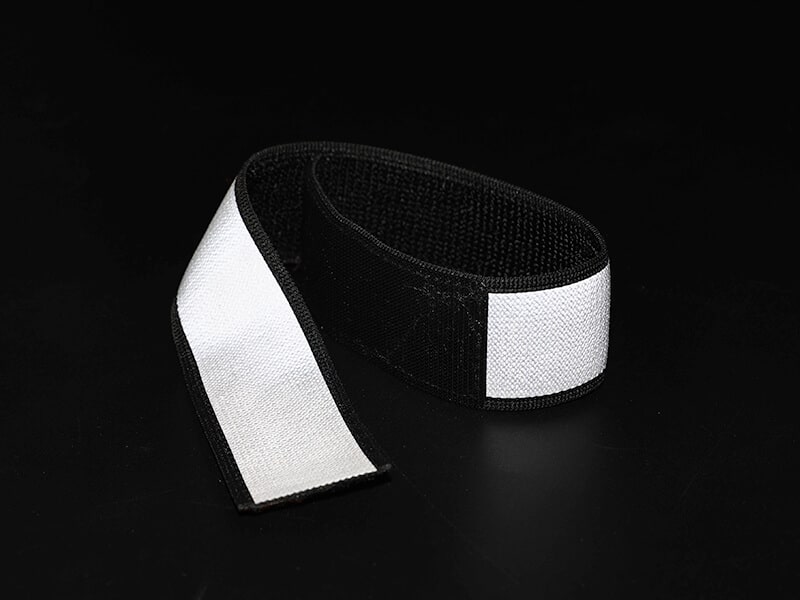
Custom Reflective Armband

Reflective Piping

Reflective Ribbon Tape