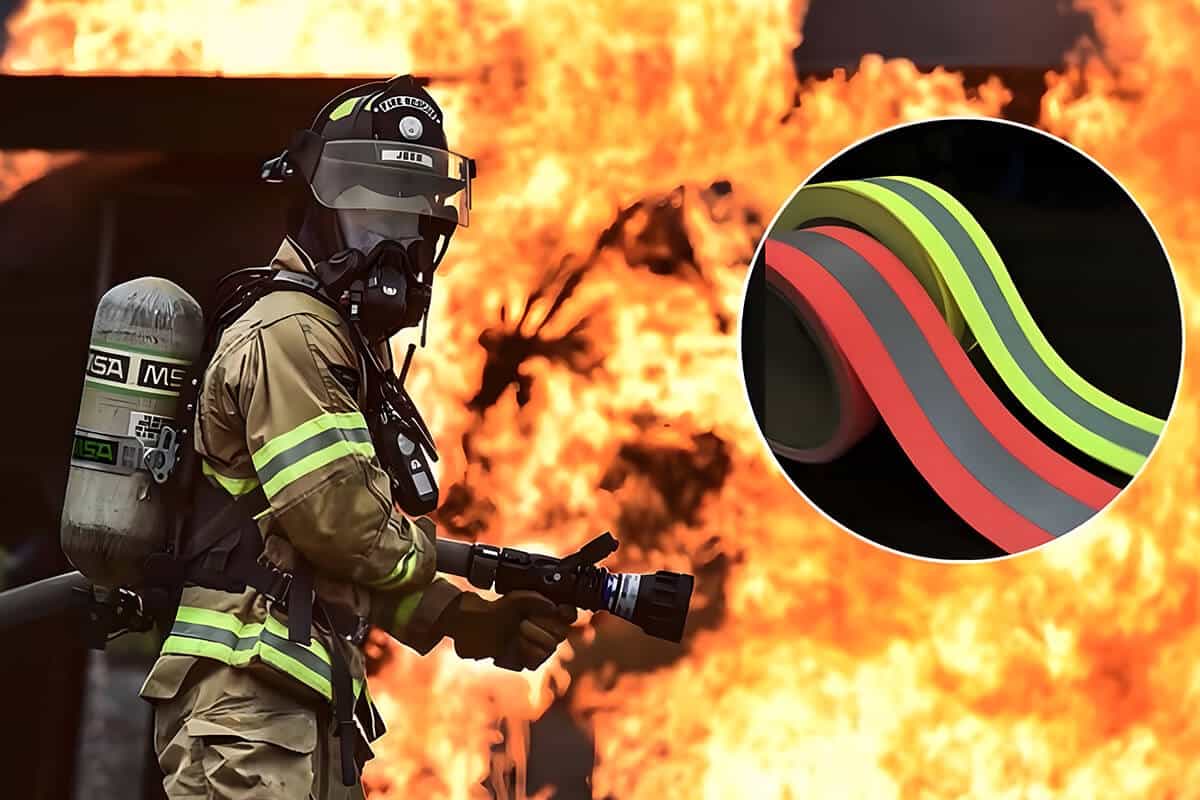
Custom reflective trim procurement needs checks from the technical brief through shipment, rather than sample appearance alone. In international apparel manufacturing, few components create as many eleventh-hour factory stoppages as custom reflective trims. A purchasing team approves a visually appealing swatch, places a bulk order of 20,000 meters, and ships the goods to an overseas garment factory—only for the factory to discover that the trim ripples aggressively during seam pressing, delaminates on DWR-coated shells, or sheds micro-glass beads during mandatory pre-shipment wash tests.
These compounding failures rarely stem from intentional supplier negligence. Rather, they occur because buyers and suppliers frequently treat sample approval as a single binary event rather than an engineering progression across defined verification gates. A loose hand swatch evaluates color and aesthetic surface luster; it does not validate slit edge straightness, thermal shrinkage compatibility, or adhesive cross-linking.
To safeguard production timelines and prevent costly garment re-works, global sourcing teams must govern custom reflective procurement through five rigorous verification gates.
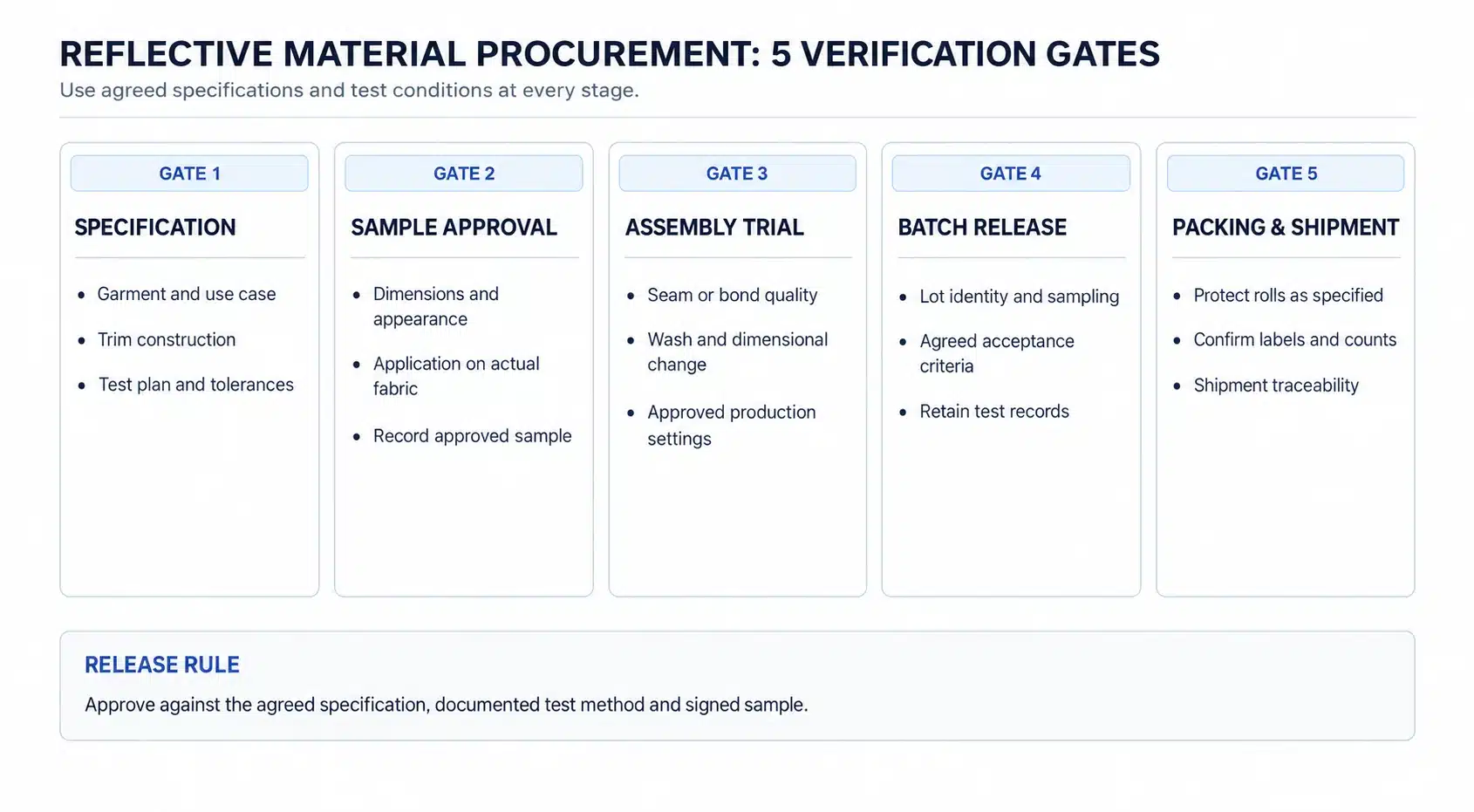
Gate 1: Specification & Substrate Audit (The Technical Brief)
Every successful trim procurement begins with a complete technical brief that addresses how the reflective material will interact with the garment shell. Simply requesting “50 mm silver reflective tape” leaves over twenty manufacturing variables undefined.
Carrier Fabric Matching
The backing fabric of the reflective trim must be chemically and mechanically compatible with the garment shell:
- Polyester Taffeta / Pongee Shells: Pair with lightweight 100% polyester reflective backings.
- Heavyweight Poly-Cotton Workwear (TC Twill): A 65/35 TC backing (typically 180–220 GSM in this example) is a candidate to evaluate for compatible tensile strength and needle-tear resistance.
- Stretch Knits / Activewear: Requires 4-way stretch spandex-backed reflective trims or segmented heat transfer vinyl (HTV). Applying rigid woven tape across elastic seams can cause broken stitches or severe localized fabric distortion.

Laundering Tier Alignment
Define the exact cleaning regimen before requesting pricing:
- Domestic Home Laundering: Specify the ISO 6330 washing and drying procedure and cycle count; the example here is 25–50 cycles at 60°C, using a suitable thermoplastic polyurethane (TPU) adhesive formulation.
- Industrial Rental Laundry: Specify the ISO 15797 washing and finishing procedure and cycle count. The industrial process example here involves 50 cycles at 75°C–85°C with alkaline detergent, followed by 160°C tunnel drying; a cross-linked thermoset polyurethane is one construction to validate for that process.
Technical Note: Over-specifying industrial wash performance for promotional or retail outerwear adds 100% to 180% in unnecessary material costs. Conversely, under-specifying domestic wash trim for industrial workwear can cause delamination in commercial laundry tunnels.
Gate 2: Lab Dips, Precision Slit Trials & Tooling Proofs
A common procurement error is committing to bulk production based solely on an A4 hand swatch. In reflective manufacturing, three distinct pre-production proofs are required:
| Sample Tier | Format / Quantity | Primary Objective | What It Does NOT Validate |
|---|---|---|---|
| Tier 1: Lab Swatch | 10–20 cm loose cut | Evaluates daytime color matching and initial hand feel. | Slitting straightness, roll winding tension, machine wash durability. |
| Tier 2: Slit Trial Roll | 10–50 m continuous roll | Tests slitting width tolerance (±1.0 mm), edge fraying, and automated folder feeding. | Full batch color consistency across 5,000+ meters. |
| Tier 3: Tooling / Print Proof | 5–10 m printed web | Verifies screen cylinder repeat pitch, registration, and logo opacity. | Large-scale tensile wash fatigue. |
Tooling Proof Verification
For decorated trims (screen-printed logos or segmented laser-cut transfer films), inspect the print cylinder proof under an optical loupe:
- Ensure print repeat intervals divide evenly into standard rotary circumferences (640 mm or 914 mm).
- Check ink edge definition: Inks applied over micro-glass bead surfaces must maintain sharp boundaries without capillary bleeding along bead interstices.

Gate 3: Garment Assembly & Pre-Production (PP) Wash Trial
Once pre-production slit rolls arrive at the garment factory, the technical development team must run mock-up seam trials before releasing bulk shell fabric for cutting.
The Differential Thermal Shrinkage Test
Reflective composites and textile shells react differently to heat and moisture:
- When exposed to steam pressing (130°C–150°C) or repeat home laundering, untreated cotton/poly shells may shrink by 2.0% to 3.5%, while a pre-stabilized polyester reflective tape may shrink by less than 0.5%.
- This variance produces differential puckering (the “accordion effect”), where the reflective tape ripples uncontrollably along the seam line.
- Remedy: Ensure the trim backing fabric is certified as heat-set and pre-shrunk, and run a 3-cycle wash trial on mock-up garment seams before bulk cutting.
Differential Shrinkage Defect Mechanism
- Shell Fabric Shrinkage (2.5%)
- Shrinks shorter
- Reflective Tape Shrinkage (0.5%)
- Relatively longer remaining tape length
- Resulting Garment Seam
- Severe puckering / rippling

DWR Chemical Audit for Heat Transfer Films
If applying segmented reflective heat transfer film (HTV), test the shell fabric’s water-repellent finish:
- Modern eco-friendly fluorocarbon-free (C0) Durable Water Repellent (DWR) chemistries utilize silicone or paraffin emulsions that dramatically lower fabric surface energy.
- Where the coating and test method are suitable, use dyne test pens as a wetting screen. The below 36 dynes/cm value is a screening example, not a universal textile bonding limit; confirm adhesion with peel and wash trials on the actual shell.
- With the trim and shell suppliers, validate compatible localized primers or press settings (the example here is 3.5–4.5 kgf/cm² at 150°C for 15 seconds), or switch to sew-on tape.
Gate 4: Top of Production (TOP) Batch Audit
The Top of Production (TOP) sample is drawn directly from the first 500 meters of the bulk production run. This gate prevents mass defect replication across tens of thousands of meters.
Mandatory Factory Floor Audit Criteria
- Continuous Roll Integrity: Verify that rolls are continuous 100-meter lengths on rigid cores. Specify a maximum allowable splice frequency (the purchase specification used here allows no more than one ultrasonic splice per 100 meters, clearly flagged with red indicator tape).
- Batch Photometric Measurement: Using a handheld retroreflectometer, test retroreflection (Ra) at five points across the web:
- High-Index Silver Trim: The buyer acceptance target used here is Ra above 450 cd/(lx·m²) at entrance angle 5° and observation angle 12’. This is a material target, not proof of an EN ISO 20471 garment class.
- Combined Performance Fluorescent Trim: The buyer acceptance target used here is Ra above 175 cd/(lx·m²) alongside chromaticity box verification; confirm the required test geometry and the full applicable material requirements.
- Bead Adhesion Cross-Hatch Test: Agree a tape-peel and bead-shedding check suited to the textile construction. If adapting ASTM D3359 cross-hatch testing, document the agreed adaptation: its standard scope concerns coatings on metallic substrates, so it does not by itself certify bead retention on textile trims. Record any powder shedding during the separate mechanical scratching check.
Gate 5: Moisture-Barrier Packaging & Ocean Transit Protection
The final point of failure occurs during logistics. Even perfectly manufactured reflective trims can degrade before arriving at the destination port if packaging is sub-standard.
The Silver Oxidation Trap
The brilliant retroreflection of silver glass bead trims relies on a microscopically thin vacuum-deposited aluminum hemispherical reflector layer. Aluminum is highly reactive to airborne moisture and maritime salt air:
- During 25 to 40 days of ocean freight across high-humidity equatorial zones, container interior temperatures fluctuate between 20°C and 60°C, causing condensation (“container rain”).
- If reflective tape is packaged in unsealed cardboard cartons with standard paper wrappers, moisture penetrates the roll layers, promoting corrosion of the aluminum reflector layer. The trim arrives at the garment factory with cloudy, dull grey streaks and photometric losses exceeding 50%.
Technical Note on Export Packaging: The packaging specification in this example includes the following; validate barrier performance and desiccant loading for the pack size and route:
- Heavy-duty 3-inch rigid cardboard inner cores (preventing core collapse under pallet stacking);
- Primary wrap in heat-sealed polyethylene (PE) or aluminum-foil moisture barrier film;
- Two 50-gram silica gel desiccant pouches inside each carton liner;
- Double-wall corrugated export cartons (ECT ≥ 44) secured with strapping bands.
Custom Reflective Trim Procurement Checklist: From Spec to Sign-Off
| Milestone | Key Action Item | Sign-off Responsible | Critical Deliverable |
|---|---|---|---|
| Briefing | Match backing fabric chemistry and laundering tier (ISO 6330 vs ISO 15797). | Sourcing Manager | Technical Specification Sheet |
| Sampling | Slit 20 m trial rolls to test auto-feed guides and rotary knife tolerances (±1.0 mm). | Pattern Engineer | Approved Slit Swatch & Lab Dip |
| Pre-Production | Conduct 3-cycle wash trial on mock-up garment seams to audit differential puckering. | Garment QA Lead | Seam Stability Report |
| Bulk Run | Audit first 500 m for Ra ≥ 450 cd/(lx·m²), splice count (≤1/100m), and web tension. | Factory QC Inspector | TOP Inspection Certificate |
| Dispatch | Verify moisture-barrier foil wrap, silica desiccants, and pallet strapping. | Logistics Lead | Export Compliance Checklist |
Frequently Asked Questions
What is the difference between a Lab Dip, a PP Sample, and a TOP Sample?
A Lab Dip is a small visual swatch (10–20 cm) created to approve daytime color shade and aesthetic texture. A Pre-Production (PP) Sample is a continuous 10–50 meter roll used to test garment sewing lines, auto-cutters, and preliminary wash shrinkage. A Top of Production (TOP) Sample is pulled directly from the initial output of the final industrial bulk run to certify that mass production matches the approved standard in photometrics, adhesion, and winding quality.
How can a buyer prevent rolls from containing excessive hidden splices?
Specify roll continuity terms in the initial purchase agreement. High-speed garment sewing lines jam when a tape splice feeds unexpectedly through an automatic folder. Require that all 100-meter rolls have no more than one factory splice per roll, with any splice clearly marked on the roll edge using brightly colored high-visibility indicator tags.
Can reflective trim be stored long-term in garment factory warehouses?
Yes, provided warehouse climate conditions are controlled. Reflective materials should be stored between 15°C and 25°C at relative humidity below 60%, away from direct sunlight and heat pipes. Rolls must remain inside their sealed moisture-barrier bags until ready for immediate production. A supplier-declared shelf life may be up to 24 months for the specified unopened rolls; confirm the product data sheet and storage conditions before relying on retained photometric performance.
What should a buyer do if heat transfer film fails to bond to a DWR-treated shell fabric?
First, review the shell finish and run a bonding trial. Where a dyne pen method is suitable for the coating, a result below 36 dynes/cm can be used as a screening flag rather than a universal pass/fail limit. Within the trim and shell suppliers’ approved settings, trial a 2–3 second dwell increase and 4.0 kgf/cm² pressure; use a fully cooled (100% cold) peel only if the film requires it. If peeling persists, validate a compatible adhesion promoter/primer or transition to sew-on reflective tape.

Related blogs
Custom Reflective Accessories RFQ Guide: 8 Technical Specs Suppliers Need Before Quoting
Custom Printed Reflective Tape
Custom Reflective Gear: Sew-On vs. Heat Transfer & The OEM Process
Reflective Piping for Clothing
Related products

Reflective piping

Reflective ribbon tape

PVC Reflective Tape