

Reflective piping dimensions often appear as a short string of numbers, but each number controls a different part of the finished trim. If a garment buyer sends only one width, the supplier may not know whether it refers to the exposed reflective face, the full sewing width or the inner cord.
This guide explains how to read a specification such as 13 mm + 16 mm + 2 mm, how each dimension affects garment construction, and what to confirm before requesting a sample or placing a bulk order.
Reflective piping dimensions at a glance
A complete reflective piping specification normally separates three measurements. They should be written in a fixed order and supported by a drawing or approved sample whenever possible.
| Measurement | What it describes | Why it matters |
|---|---|---|
| Reflective visible width | The exposed reflective surface visible after the piping is installed | Controls the visual line, reflective area and finished appearance |
| Total width | The full flat width, including the reflective section and sewing allowance | Determines how easily the piping can be positioned and sewn into a seam |
| Cord diameter | The diameter of the cotton, plastic or PVC core inside a cored profile | Controls how rounded, raised and structured the finished edge looks |
Reflective visible width
The visible width is the part a user sees on the finished garment or accessory. A narrow reflective face creates a subtle design line around a seam. A wider face creates a bolder visual effect and returns light over a larger area, although finished-product visibility and compliance depend on the complete garment design rather than one trim dimension alone.
Total width and sewing allowance
Total width is measured while the piping is flat. It includes the area that disappears into the seam. This hidden allowance is critical in production: if it is too narrow for the selected fabric or sewing process, operators may struggle to hold a consistent seam line.
Cord diameter
The cord creates the familiar rounded profile of traditional piping. A larger cord produces a more pronounced edge, while a smaller cord gives a finer finish. Some reflective edging products are supplied without a cord; in that case, the specification should state that the trim is flat rather than leaving the third measurement ambiguous.
How to read 13 mm + 16 mm + 2 mm
For this test specification, read the numbers in a fixed sequence.
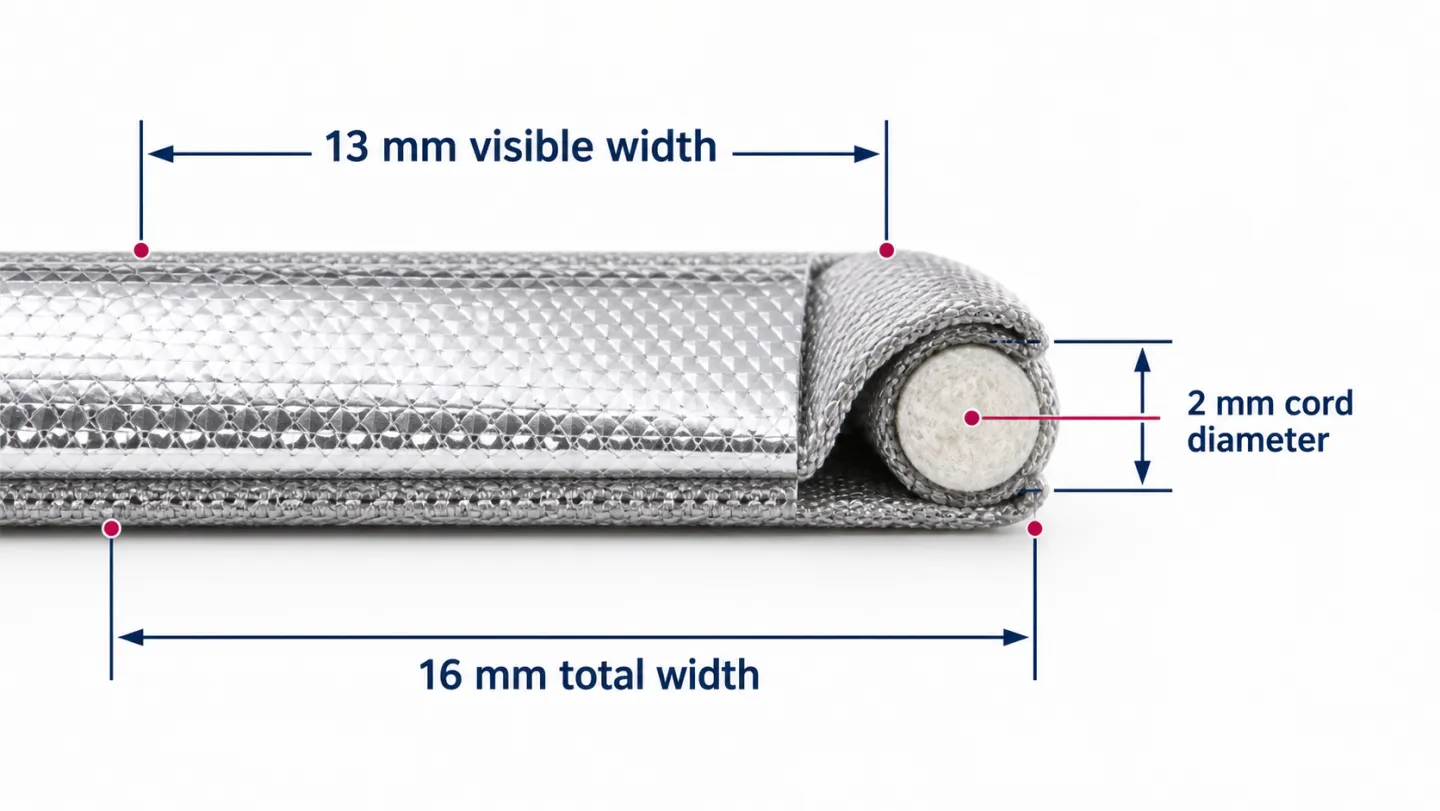
Confirm each number in order
13 mm reflective visible width
The first number is the reflective portion intended to remain visible in the finished construction.
16 mm total width
The second number is the complete flat width supplied to the sewing line, including the hidden allowance.
2 mm cord diameter
The third number is the internal core that forms the rounded edge.
The notation is compact, but it should not replace a technical drawing. During sampling, confirm where each measurement begins and ends, because buyers and factories sometimes use different naming conventions for the same trim.
What does 15 mm + 16 mm without a third number mean?
A two-number specification may describe a flat or non-cored construction, but that must be confirmed. Write no inner cord or flat reflective edging on the specification sheet so the factory does not infer a missing value.
How size changes the finished product
Reflective piping should be selected as part of the whole product, not as an isolated accessory. The right size depends on the desired appearance, garment fabric, seam construction, wash conditions and visibility objective.
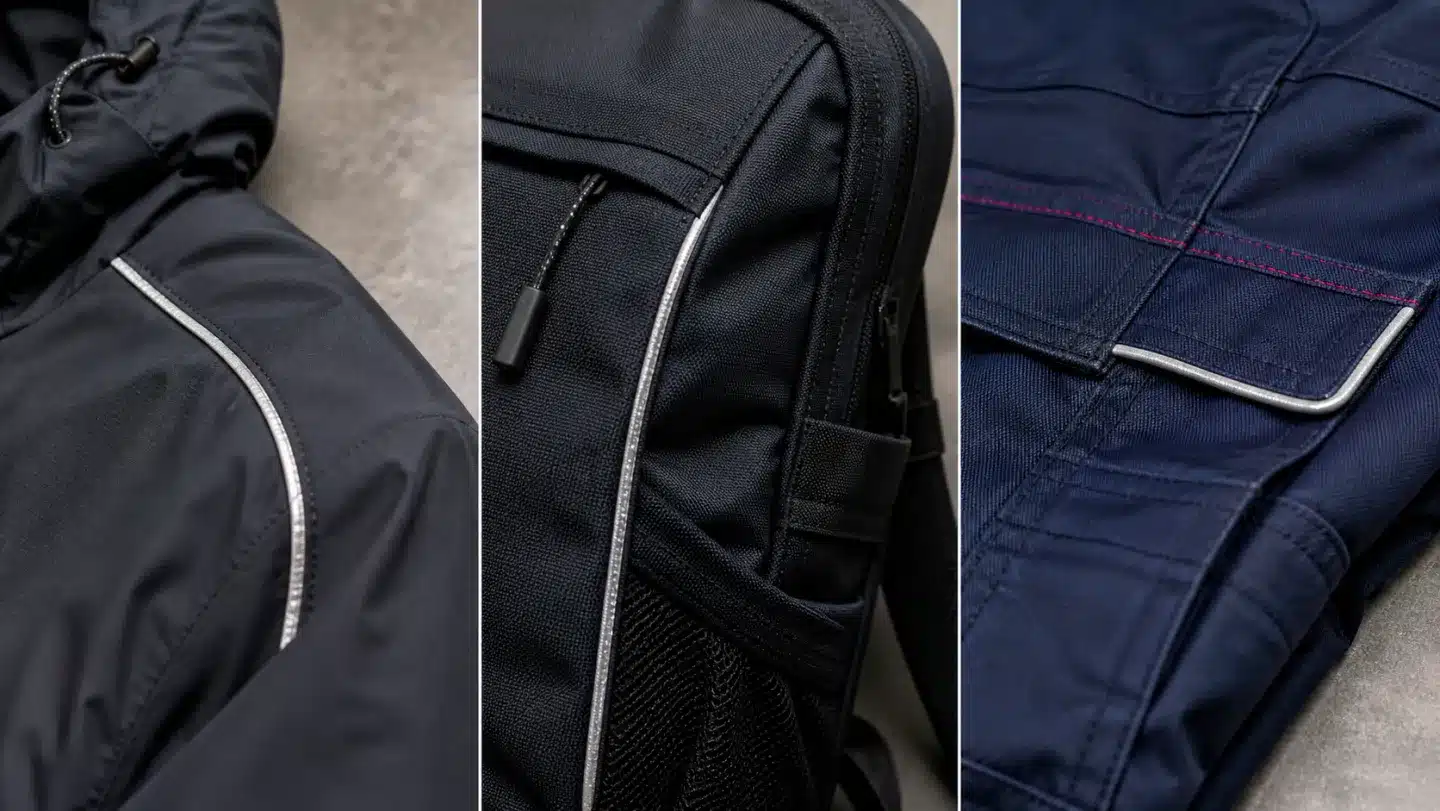
Footwear and fashion apparel
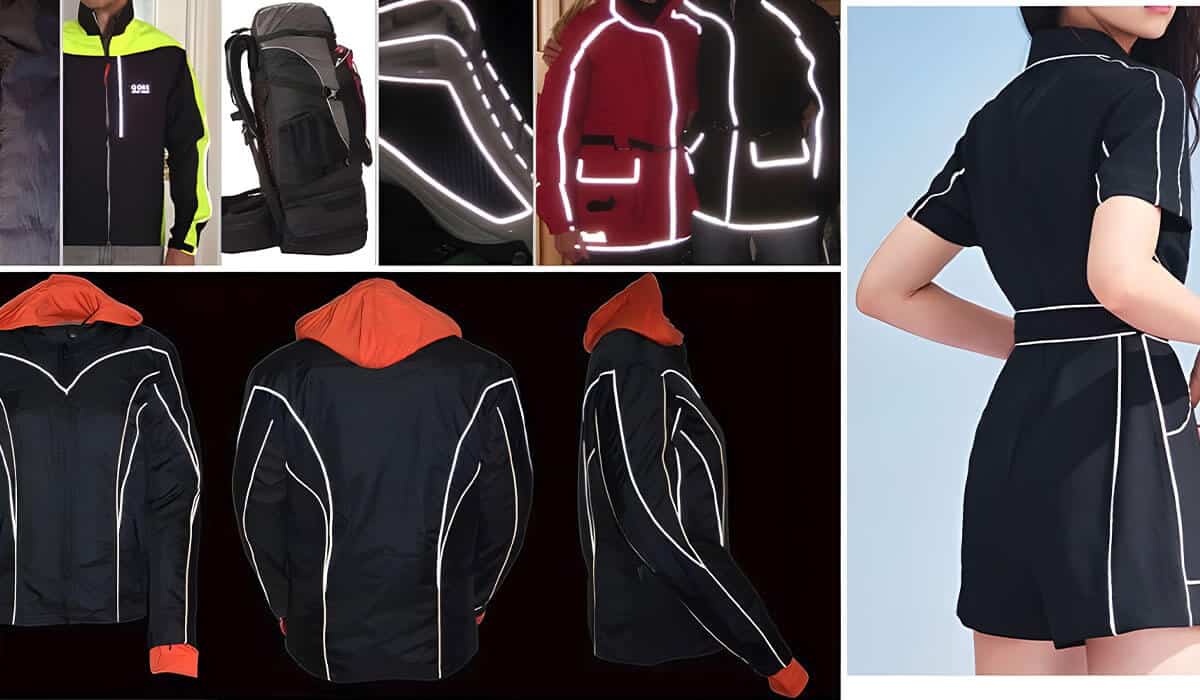
Fine reflective profiles can follow curved panels and create a clean decorative edge. For fashion-led products, the design team should evaluate the trim in normal daylight as well as under directed light. A narrow line may be visually elegant without providing the reflective area expected from a broad safety tape.
Sportswear and outdoor bags
Sportswear and bags often need a balance of visibility, flexibility and low bulk. MAX's reflective piping guidance identifies total widths around 15–16 mm as a common starting point for these applications. The final choice still needs a sewing trial on the actual shell, lining or webbing construction.
Safety vests and workwear
Workwear buyers may prefer a wider reflective face and reinforced seam allowance, particularly at high-stress edges. If the finished garment must meet a safety standard, request the applicable material test documentation and assess the finished garment construction. Do not assume that adding a narrow strip of reflective piping automatically makes the garment compliant.
Cored piping versus flat reflective edging
| Feature | Cored reflective piping | Flat reflective edging |
|---|---|---|
| Profile | Rounded and three-dimensional | Flat or lightly raised |
| Specification | Visible width + total width + cord diameter | Visible width + total width + explicit no-cord note |
| Typical design effect | Defined seam edge and stronger visual contour | Cleaner, lower-profile line |
| Production check | Confirm cord material, diameter and bending performance | Confirm stiffness, fold behavior and sewing allowance |
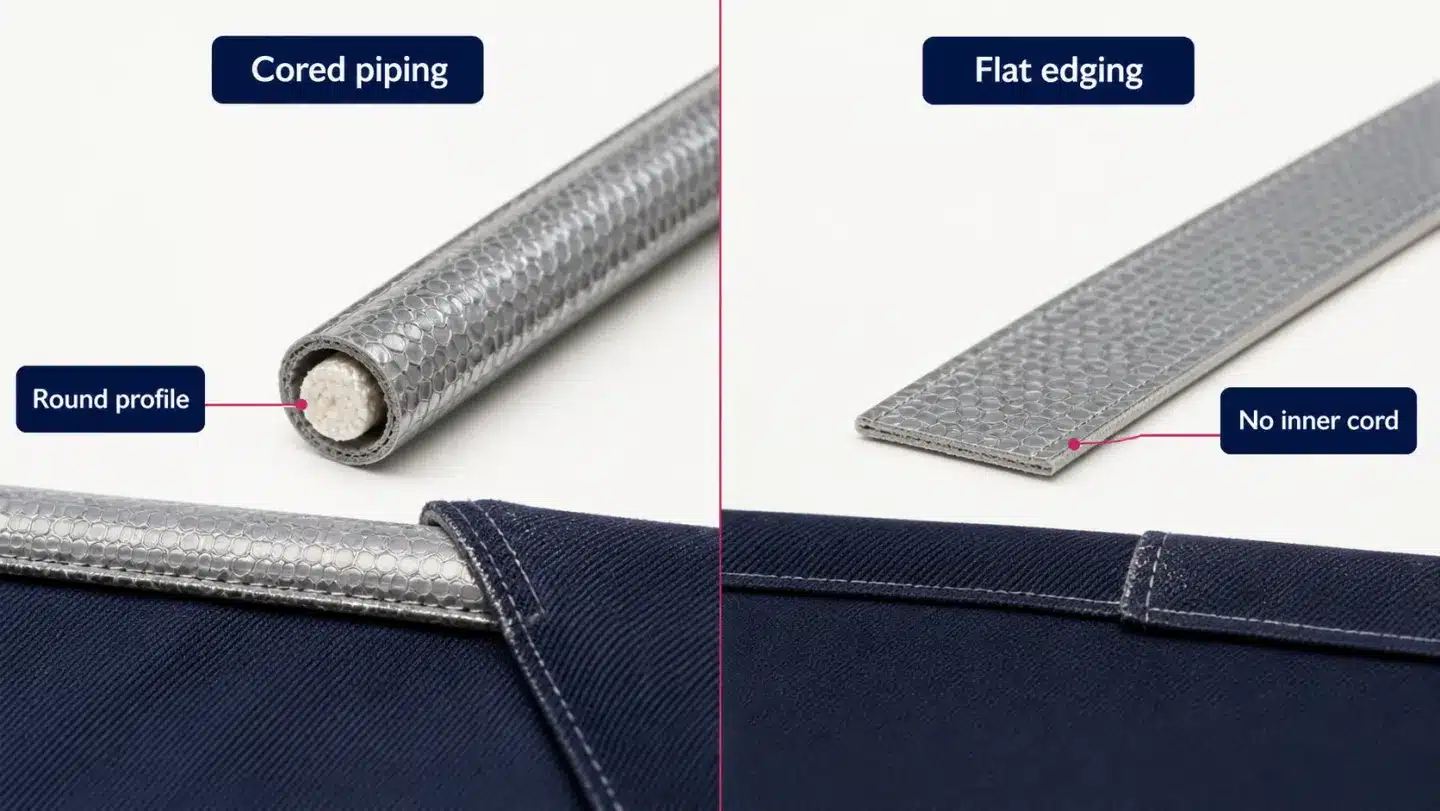
Sewn constructions commonly use a cotton cord, while other processes may use plastic or PVC cores. The core material should match the desired hand, curvature and production method.
What to put on a reflective piping specification sheet
A clear specification reduces sampling rounds and prevents a visually similar but technically different trim from reaching bulk production.
- End use: jacket, safety vest, backpack, footwear, hat or another application.
- Reflective visible width: state the measurement in millimetres.
- Total width: include the full sewing allowance.
- Core: specify whether it is required, plus its material and diameter.
- Base material: for example polyester, polyester-cotton or an elastic construction.
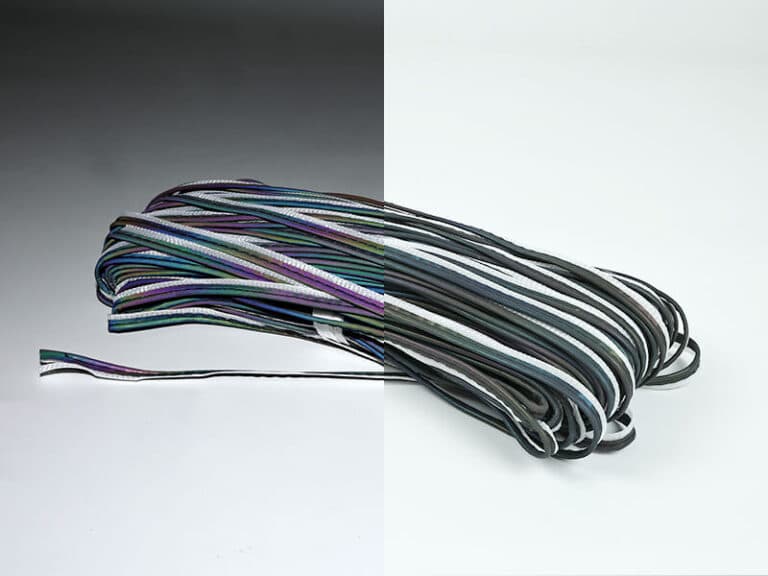
- Color and appearance: silver, grey, fluorescent, colored, rainbow or printed.
- Reflectivity requirement: provide the target value or applicable test requirement instead of asking only for “high reflective.”
- Wash conditions: define home or industrial laundering expectations and the intended cycle.
- Garment fabric and seam: provide the actual fabric or a representative sample for compatibility testing.
- Packaging: confirm roll length, labeling and any splice limitations.
Add a drawing and an approved physical sample
A cross-section drawing eliminates uncertainty about visible width, seam allowance and core diameter. After the first sample is approved, seal and label one physical reference sample for both the buyer and factory. The approved sample should remain the visual and dimensional benchmark for bulk inspection.
Common mistakes when ordering reflective piping
Sending only one width
A message such as “we need 15 mm reflective piping” is incomplete. The supplier still needs to know whether 15 mm refers to the visible reflective face or the full flat width.
Ignoring the sewing allowance
A trim can look correct on a sample card yet be difficult to sew into a real garment. Confirm that the allowance suits the seam type, fabric thickness and factory equipment.
Not specifying the core
Cotton cord, plastic core and no-core constructions can behave differently around curves and after washing. State the material and diameter, then bend the sample around the tightest radius used in the product.
Approving appearance without testing production
Before bulk production, test sewing consistency, bending, abrasion, washing and reflective appearance on the intended product. The most useful sample is not a loose strip; it is a sewn prototype made with the actual materials and process.
How to request the right sample
Send the supplier a short but complete request that includes the application, dimensional notation, material, color, reflectivity target, wash requirement and estimated quantity. For example:
Reflective piping for an outdoor backpack: 13 mm visible reflective width + 16 mm total width + 2 mm cotton cord, silver polyester construction, home-wash requirement, with a sample for seam and abrasion testing.
If you are unsure which construction fits your product, share the garment or accessory design and the intended use. MAX can help compare reflective piping options and prepare a sample specification before bulk ordering. Review the reflective piping FAQ or explore the complete reflective piping range.
Frequently asked questions
What are the three main reflective piping measurements?
They are the reflective visible width, total flat width and inner cord diameter. If the product has no cord, state that explicitly.
Is a wider reflective piping always better?
No. A wider reflective face may create a bolder appearance and more reflective area, but it can also change flexibility, seam construction and design balance. Select the width for the complete product and its intended performance.
Can reflective piping alone make a garment compliant?
Not automatically. Compliance depends on the applicable standard, certified material performance, total placement and area, garment design and finished-product assessment.
Should the sample be tested on the final fabric?
Yes. Sewing behavior, curvature, abrasion and wash performance can change when the piping is combined with the actual shell fabric, lining, webbing and seam construction.

Related blogs
Reflective Piping for Clothing

Sewn Type vs. High-Frequency Hot-Pressing Reflective Piping

Common Reflective Piping Problems and How to Avoid Them

Why Reflective Piping Is Gaining Popularity
Related products

Regular Silver Reflective Edging Piping

Colored Reflective Piping
Rainbow Reflective Piping


