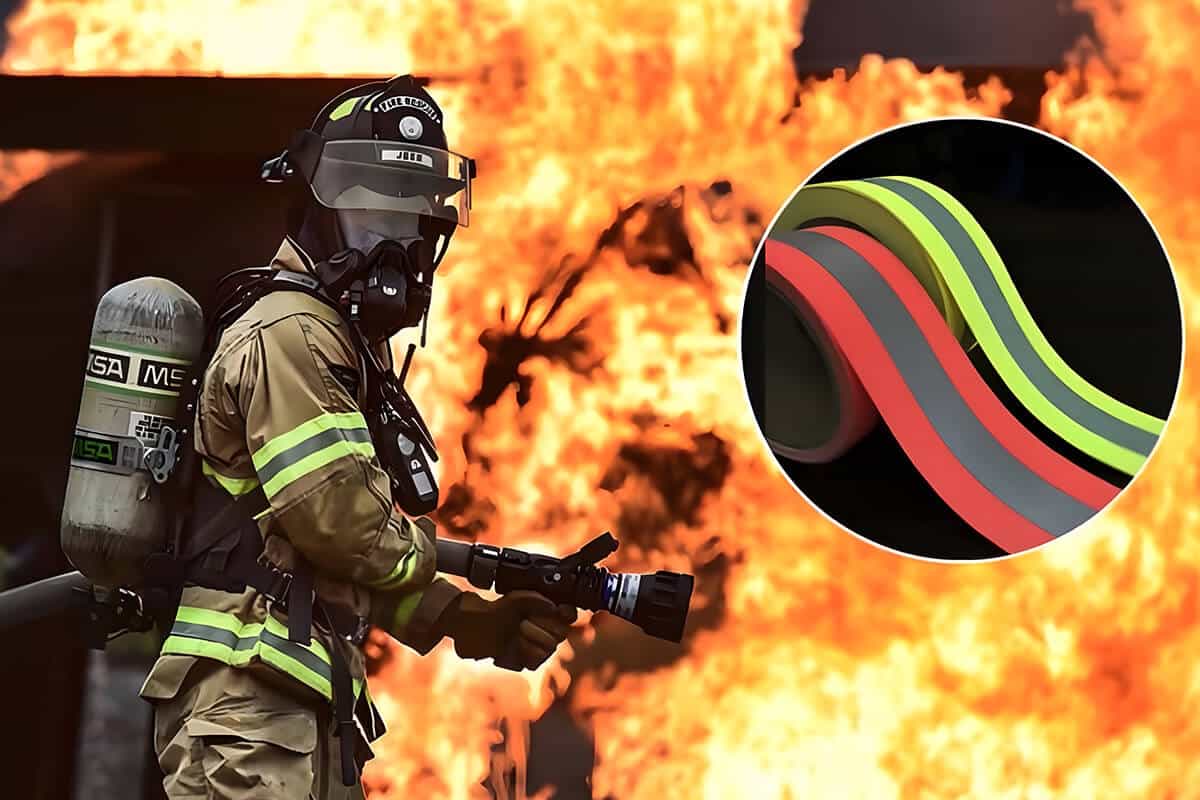
Selecting retroreflective materials for professional workwear and Personal Protective Equipment (PPE) is fundamentally an exercise in environmental and mechanical compatibility. In a digital rendering or an indoor showroom, nearly all high-index reflective trims appear blindingly bright. Yet in harsh operating environments—such as sub-zero mining operations, wet offshore oil platforms, road construction under torrential rain, or commercial industrial laundries—unsuitable materials fail catastrophically.
A micro-prismatic PVC badge suited to a road cone can crack when flexed at -15°C on an Alaskan utility parka if its formulation is unsuitable for that temperature. Similarly, a high-index glass bead fabric with strong dry laboratory retroreflection can experience photometric degradation when overwhelmed by sheets of surface water on maritime rainwear. EN ISO 20471 Class 2 applies to the complete garment assessment, including material performance, areas and placement.
Navigating these trade-offs requires sourcing teams to understand the four primary material architectures that dominate technical apparel, evaluating them across optical physics, environmental limits, and total lifecycle costs.
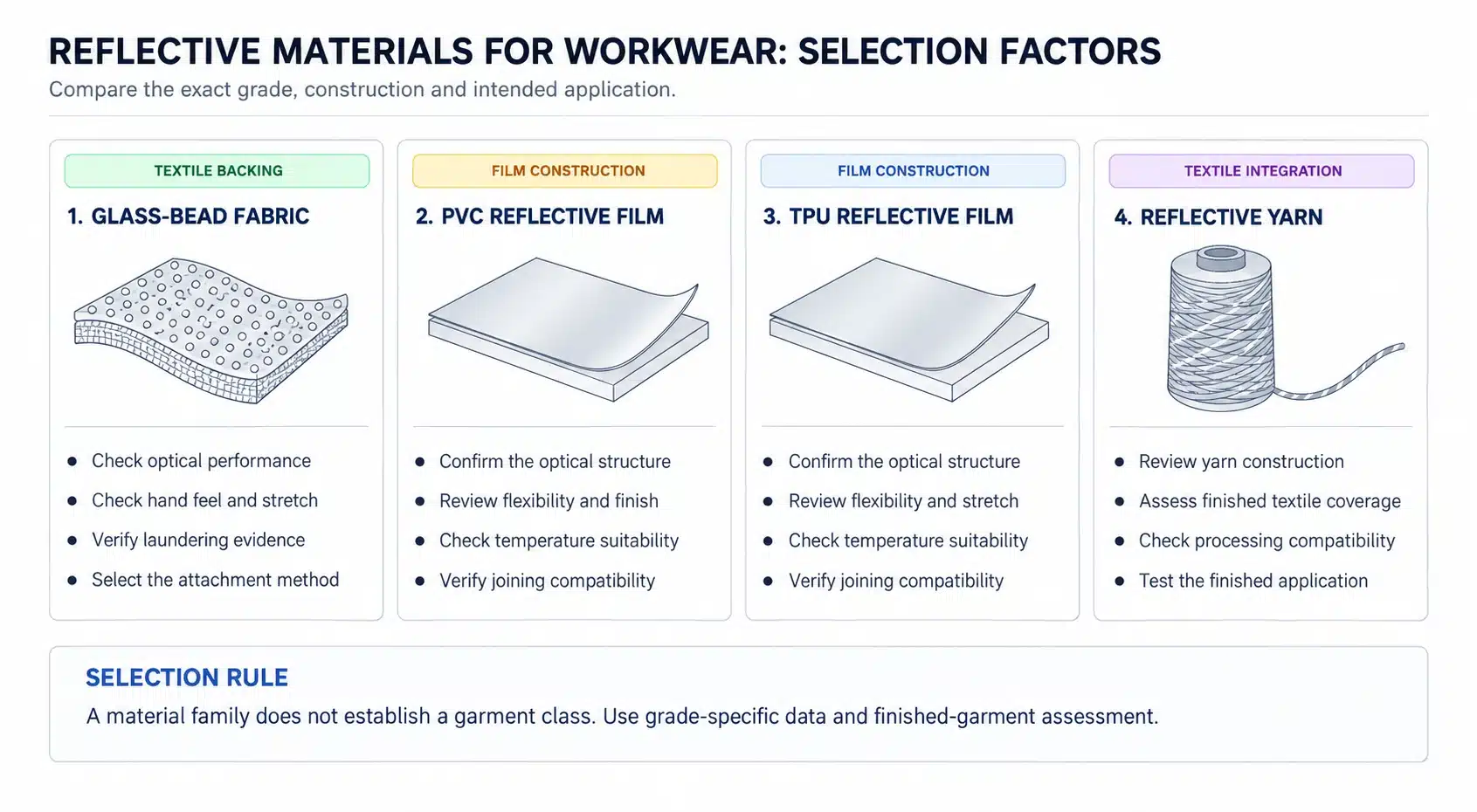
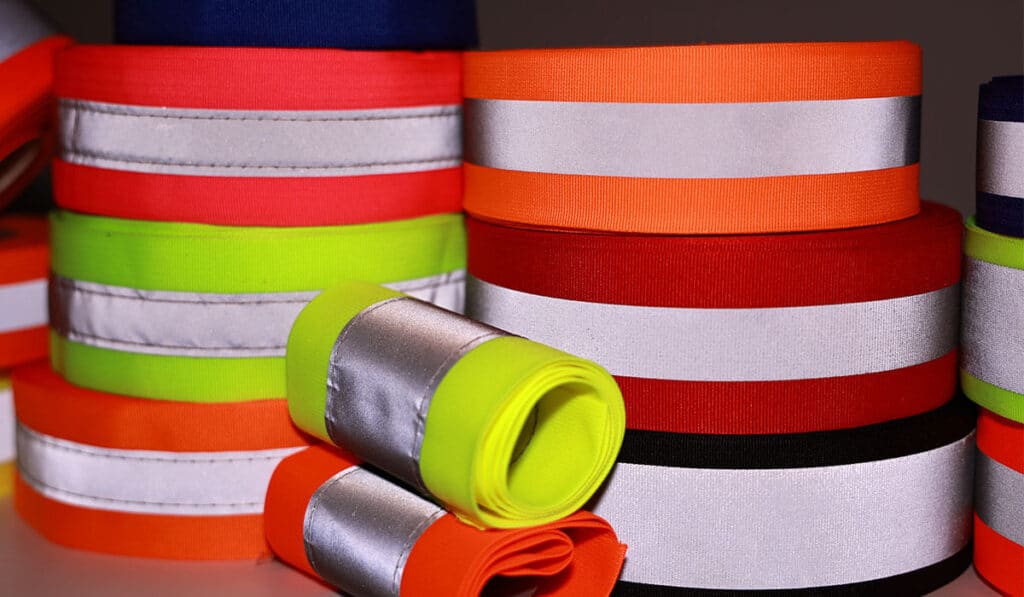
Micro-Glass Bead Retroreflective Fabric (The Global Workhorse)
Micro-glass bead fabric is widely used in high-visibility garments, with suitable constructions evaluated against standards such as EN ISO 20471, ANSI/ISEA 107, and AS/NZS 1906.4.
Optical Mechanism & Architecture
Glass bead technology utilizes spherical, high-refractive-index glass beads (refractive index n ≈ 1.90–1.93) measuring 40 to 90 microns in diameter. These beads are embedded half-way into a polymer binder layer, with their rear embedded hemispheres coated in a vacuum-deposited vaporized aluminum mirror.
- Refraction & Reflection: Light enters the front spherical surface of the bead, refracts downward, focuses onto the rear aluminum mirror, and reflects back through the bead directly toward the light source.
- Wide Angularity: Because the beads are spherical, they exhibit exceptional wide-angle performance, maintaining high retroreflection even when light strikes the garment at severe entrance angles (up to 40°–50° off-perpendicular).
Mechanical Strengths & Laundering Chemistry
- Substrate Versatility: Glass beads can be laminated to 100% polyester taffeta for light vests, heavy 65/35 TC twill for work jackets, inherently flame-resistant (FR) aramid fabrics for flash-fire coveralls, or elastomeric knit backings for stretch panels.
- Laundering Durability: Selected high-performance glass bead fabrics formulated with cross-linked thermoset polyurethanes may be specified for up to 50 industrial wash cycles. The example here uses 75°C washing with alkaline detergent and 160°C tunnel finishing; record the selected ISO 15797 test procedure, finishing method and cycle count, and validate the intended laundry process.

Engineering Vulnerabilities
- Surface Water Sheeting: When exposed to continuous torrential rain, an unbroken sheet of water can form across the exposed glass beads. Because water has a refractive index (n ≈ 1.33) significantly higher than air (n ≈ 1.0), it alters the refraction angle at the bead interface, scattering light and reducing dry retroreflection by 30% to 50% unless the fabric is treated with a specialized hydrophobic nanocoating.
Micro-Prismatic PVC (Vinyl Film): High-Gloss Wet-Weather Luminance
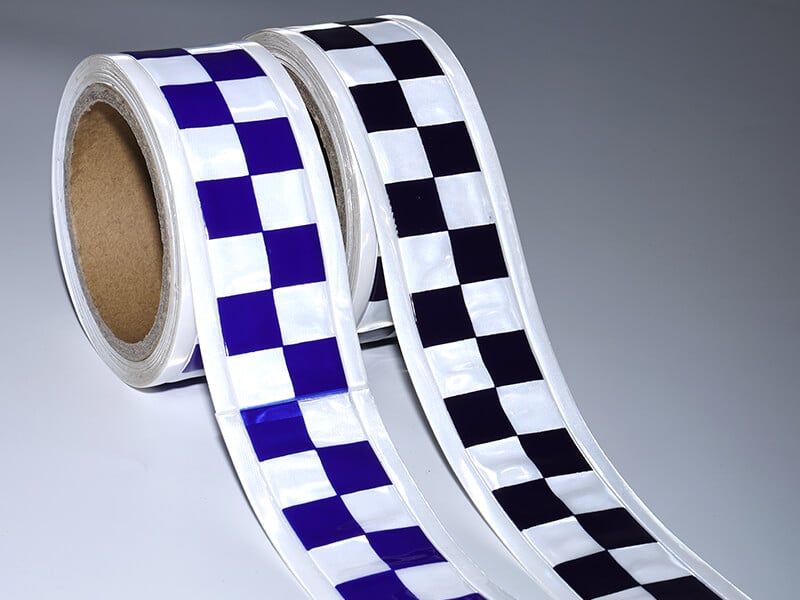
Micro-prismatic Polyvinyl Chloride (PVC) tape is the classic high-gloss, segmented material frequently seen on highway patrol vests, traffic management sashes, and heavy waterproof slickers.
Optical Mechanism & Architecture
Unlike spherical glass beads, micro-prismatic tape employs Total Internal Reflection (TIR):
- Thousands of microscopic retroreflective cube-corner pyramids are molded onto the underside of a flexible transparent PVC film.
- Light enters the flat front surface, bounces off three internal prism faces in sequence (x, y, and z planes), and returns 180° back to the observer.
- The Sealed Air Cell Matrix: Micro-prismatic PVC relies on air backing to maintain the refractive index differential necessary for total internal reflection. Consequently, the back of the film is ultrasonically or radio-frequency (RF) welded to a white backing film in a distinctive hexagonal or diamond lattice grid. These hermetically sealed air cells prevent water from touching the prisms, supporting high wet-weather retroreflection. Retention approaching 100% is a product/test-specific example, not a guarantee for every prismatic film or rain condition.
Application Strengths
- High-Frequency (HF / RF) Welding: PVC can be ultrasonically or dielectric-welded directly onto polyurethane or vinyl-coated rainwear, avoiding needle perforations. Validate waterproof integrity of the selected welded construction and finished garment.
- Wipe-Clean Non-Porous Surface: Oil, mud, and road grime cannot penetrate the glazed exterior face and can be easily hosed off.
Engineering Vulnerabilities & The Cold-Crack Hazard
- Plasticizer Migration & Cold Embrittlement: PVC is naturally rigid and requires liquid plasticizers (typically phthalates or trimellitates) to achieve flexibility. Over time, UV radiation and heat cause these plasticizers to evaporate or migrate, leaving the tape brittle.
- Glass Transition Temperature (Tg): Cold flexibility depends on PVC formulation, plasticizer content and aging. The -10°C limit is a cautionary example for a standard grade, not a universal PVC glass transition point. Flexing an unsuitable grade in freezing conditions can cause the tape to crack.
- Eco-Compliance: PVC formulations require review of their plasticizers, stabilizers and applicable destination-market restrictions. Restricted additives and end-of-life options vary by formulation and jurisdiction.
Micro-Prismatic TPU: Sub-Zero Resilience & Eco-Compliance
Thermoplastic Polyurethane (TPU) micro-prismatic film represents the next-generation evolution of prismatic technology, developed to overcome the chemical and thermal liabilities of PVC.
Material Architecture
TPU prism film replaces polyvinyl chloride with aliphatic or aromatic polyurethanes. The cube-corner prisms are precision micro-embossed into optical-grade elastomeric TPU resins and backed with an RF-welded or adhesive-bonded barrier layer.
Core Engineering Advantages
- Extreme Cold-Crack Resistance: Selected TPU grades can maintain elastomeric flexibility down to -30°C to -40°C. Verify low-temperature flex performance of the complete prismatic construction for Arctic offshore drilling, Nordic road maintenance or high-altitude rescue apparel.
- Hydrolysis and Abrasion Resistance: Polyether-based TPU exhibits exceptional resistance to microbial attack, oil absorption, and mechanical abrasion. For a specified construction, a 20,000-cycle Martindale abrasion target can be evaluated without exposing prism cells; confirm the test load, method and acceptance result for the selected film.
- Chemical and Certification Checks: TPU can be formulated without halogens or added volatile plasticizers, and film production can use solvent-free processes. Verify the complete trim formulation and current supporting documents for OEKO-TEX® STANDARD 100 Class I, applicable REACH SVHC obligations and any bluesign® claim; TPU chemistry alone does not establish certification or compliance.
Commercial Constraints
- Premium Pricing: TPU micro-prismatic materials carry a 50% to 100% price premium over standard PVC counterparts due to high raw polymer costs and precision tooling requirements.
- Thermal Welding Calibration: TPU requires slightly narrower processing windows during radio-frequency or hot-air seam welding compared to standard PVC.
Retroreflective Slit Yarn & Thread: Seamless Knitwear Integration
Reflective yarn (also known as reflective thread or filament) is not an applied ribbon or patch; it is an engineered technical fiber designed to be woven or knitted directly into structural textiles.
Manufacturing & Form Factor
Reflective yarn is produced by slitting continuous rolls of double-sided micro-glass bead coated polyester film into ultra-narrow flat filaments, typically ranging from 0.25 mm to 0.50 mm (0.010” to 0.020”) in width.
- It is supplied on spools as a single flat monofilament or plied/twisted together with carrier yarns (such as polyester, nylon, or aramid) to enhance tensile breaking strength on industrial knitting machinery.
Primary Use Cases
- Circular & Flat Knitting: Seamlessly integrated into high-visibility beanies, cold-weather knit caps, heavy ribbed sweater collars, glove cuffs, and sock tops.
- Braiding & Weaving: Braided into utility drawcords, zipper pullers, rescue cords, and shoelaces.
- Subtle Day-to-Night Aesthetics: Appears as an understated heather grey yarn under daylight, but illuminates brightly under direct vehicle headlights.
Critical Compliance Limitation
Technical Note on PPE Certification: Because reflective yarn naturally twists during machine knitting and interloops with non-reflective fibers, a substantial portion of the glass beads point inward toward the garment interior. Its effective retroreflective coefficient ranges between 20 and 80 cd/(lx·m²). Reflective yarn alone does not establish EN ISO 20471 or ANSI/ISEA 107 Class 2/3 compliance; the finished garment and its materials must meet all applicable requirements. It may be used as a secondary design accent, or in EN 17353 / Type B equipment only where the finished item is within scope and has been tested to the applicable requirements. Yarn is not automatically certified to EN 17353.
Engineering Decision Matrix: Workwear Material Selection
The ranges below are comparison examples for specified constructions, not universal limits or certifications for every material in a polymer family. Verify the selected product, test geometry, wet-test conditions, laundering procedure and cycle count.
| Evaluation Parameter | Micro-Glass Bead Fabric | Micro-Prismatic PVC | Micro-Prismatic TPU | Reflective Slit Yarn |
|---|---|---|---|---|
| Typical Dry Retroreflection (Ra) | 450–550 cd/(lx·m²) | 300–450 cd/(lx·m²) | 350–500 cd/(lx·m²) | 20–80 cd/(lx·m²) |
| Wet Rain Performance | Moderate (drops 30–50% unless treated) | Excellent (95–100% retention) | Excellent (95–100% retention) | Low |
| Cold Flexibility Limit | -20°C (fabric remains pliable) | -10°C (brittle fracture risk) | -35°C to -40°C (exceptional) | N/A (knitted fiber) |
| Laundering Durability | Up to 50x Industrial (ISO 15797) | 10–25x Domestic (delaminates in hot wash) | 25–50x Domestic / Light Industrial | Follows host knitwear spec |
| Attachment Method | Lockstitch sewing or Heat Transfer (HTV) | RF welding or Heavy-gauge sewing | RF welding, Heat press, or Sewing | Direct knitting / weaving / embroidery |
| Flame Retardancy Option | Available (Aramid / FR Cotton) | Poor (melts, drips, toxic HCl fumes) | Moderate (FR additives available) | Limited (FR aramid plied core) |
| PPE Compliance Assessment | May be used in EN ISO 20471 Class 2/3 or ANSI/ISEA 107 garments after full assessment | May be used in EN ISO 20471 Class 1/2 garments after full assessment | May be used in EN ISO 20471 Class 1/2 garments after full assessment | EN 17353 medium-risk equipment only if the finished item meets its scope and requirements |
| Approximate Material Cost | $0.09 – $0.85 / linear meter | $0.15 – $0.40 / linear meter | $0.35 – $0.75 / linear meter | $12 – $28 / 1,000m spool |
Sourcing Action Plan: Aligning Material to Application
- For Heavy Industrial Rental Workwear (Petrochemical, Utilities, Rail):
- Mandatory Selection: 65/35 TC or Aramid-backed Micro-Glass Bead Fabric rated for ISO 15797 industrial wash. Ensure the polyurethane binder is specified as cross-linked thermoset.
- For Foul-Weather Rainwear & Marine Oilskins:
- Mandatory Selection: Micro-Prismatic PVC or TPU. Utilize radio-frequency or ultrasonic perimeter welding to eliminate needle stitch holes, then verify the required hydrostatic performance of the welded seams and finished garment.
- For Arctic, Cold-Storage, or Sub-Zero Mining Apparel:
- Mandatory Selection: Micro-Prismatic TPU or High-Flex TC Glass Bead Fabric. Do not approve the standard PVC grade discussed here below -10°C without product-specific low-temperature flex validation.
- For Athleisure, Winter Headwear & Lifestyle Safety Trims:
- Mandatory Selection: 0.37 mm or 0.50 mm Double-Sided Reflective Slit Yarn twisted with polyester carrier thread for seamless knitwear integration. Assess EN 17353 only for finished items within its scope; equipment specifically intended for the head, hands or feet is excluded.
Frequently Asked Questions
Why does prismatic PVC crack so easily in cold winter conditions?
PVC is inherently a rigid polymer made flexible through plasticizer additives. As a formulation approaches its low-temperature flexibility limit, molecular mobility decreases and bending can cause brittle fracture. Around -10°C is the cautionary example used here for a standard grade, not a universal Tg for all plasticized PVC. Check the selected film’s low-temperature flex test rather than assuming all grades behave alike.
Can micro-glass bead fabric achieve 100% waterproof performance on rain jackets?
A waterproof garment construction is possible, but its attachment method, seam sealing and tested performance are critical. While the glass beads themselves are unaffected by moisture, needle perforations from sewing will leak water unless backed with 3-layer hot-melt seam sealing tape. Alternatively, specifying segmented heat transfer film (HTV) eliminates stitch holes entirely. To prevent surface water sheeting from dimming the beads during storms, specify trims treated with durable hydrophobic fluorochemical or C0 silane finishes.
Is reflective yarn strong enough to run through commercial computerized knitting machines?
Single-strand 0.25 mm slit monofilament yarn has relatively low tensile breaking strength (typically 1.5–2.5 N) and will snap if subjected to high dynamic tensions on multi-gauge circular knitting machines. Commercial knitters resolve this by utilizing plied or core-spun reflective yarn, where the reflective micro-ribbon is wrapped around or twisted with a high-tenacity 75D/150D polyester or nylon carrier filament.
What is the primary environmental difference between PVC and TPU trims?
The PVC polymer contains chemically bound chlorine (roughly 57% by weight). Flexible PVC uses plasticizers and stabilizers, but these need not be phthalates or heavy metals; review the actual formulation and applicable restrictions. Burning PVC can release hydrogen chloride and, under unsuitable combustion conditions, other hazardous products. TPU is an elastomer formed from polyols and diisocyanates and can be specified as 100% halogen-free and without added plasticizers. Confirm additives, the complete laminate, recycling options and safe welding conditions for the selected product; the polymer name alone does not establish worker safety or certification.

Related blogs
Custom Reflective Accessories RFQ Guide: 8 Technical Specs Suppliers Need Before Quoting
Custom Printed Reflective Tape
Custom Reflective Gear: Sew-On vs. Heat Transfer & The OEM Process
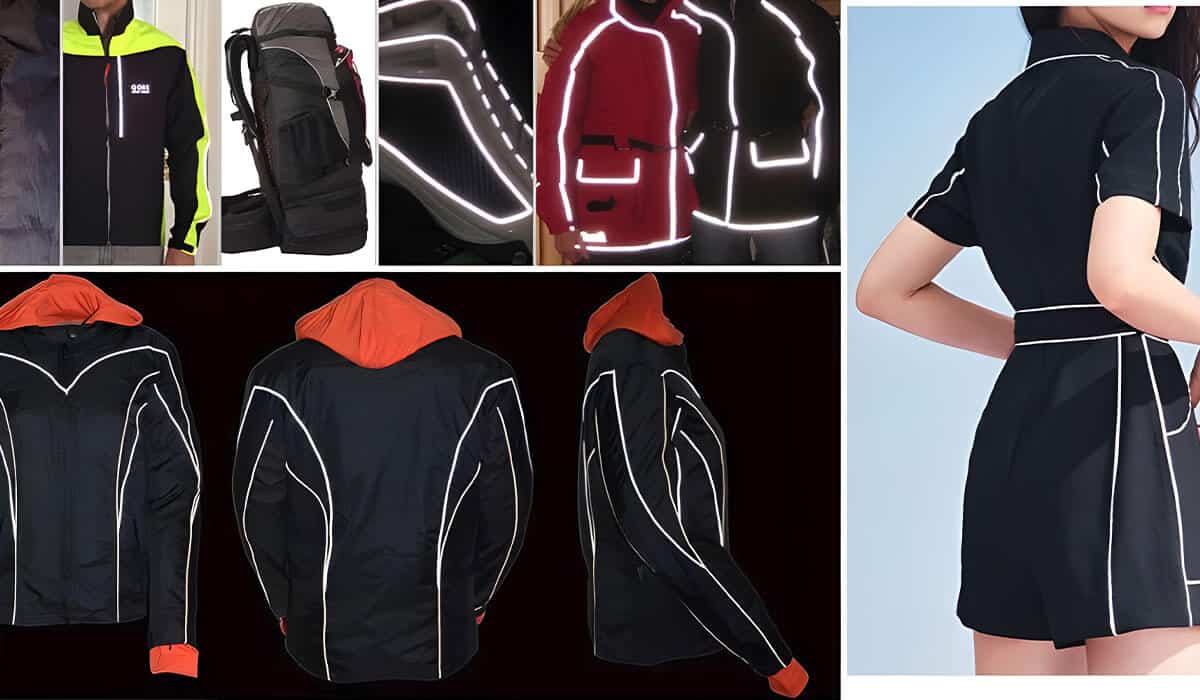
Reflective Piping for Clothing
Related products

Reflective piping

Reflective ribbon tape

PVC Reflective Tape