How Does Reflective Tape Work

Picture of Mary WANG
Mary WANG

MAX Reflective Accessories Design Director

Table of Contents

Reflective tape keeps drivers, workers, and equipment visible when ambient light disappears. It powers trailer conspicuity, road sign legibility, PPE compliance, and industrial hazard marking. But not all reflective tape performs the same — and specifying the wrong construction or grade can quietly undermine safety programs and regulatory compliance.

This guide explains how reflective tape actually works, the industry standards that classify it (ASTM D4956, DOT-C2, SOLAS 1974), and how B2B buyers can confidently choose between glass bead, microprismatic, and encapsulated lens constructions.

how-does-reflective-tape-work

What is reflective tape?

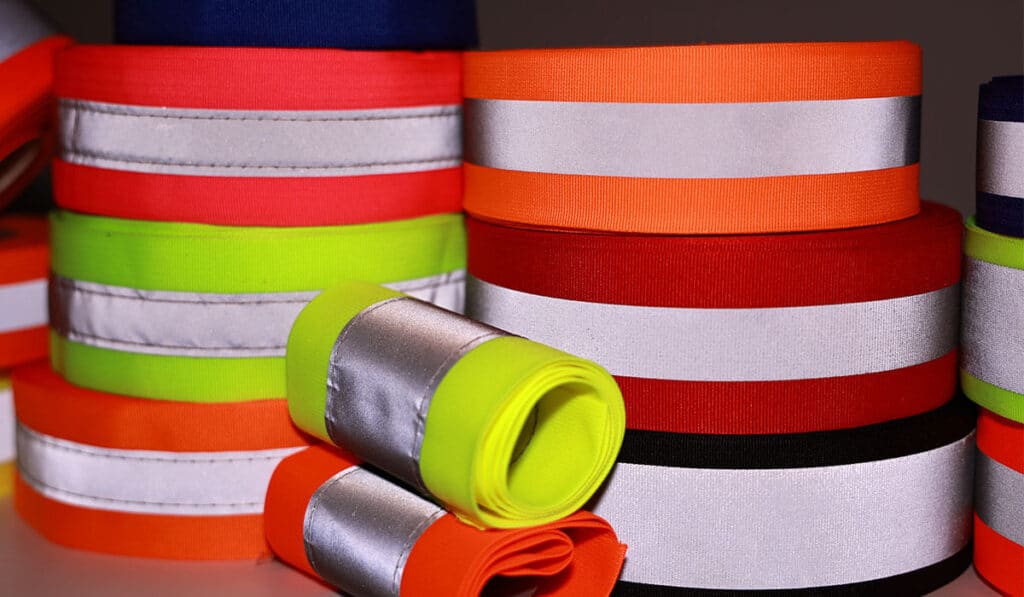
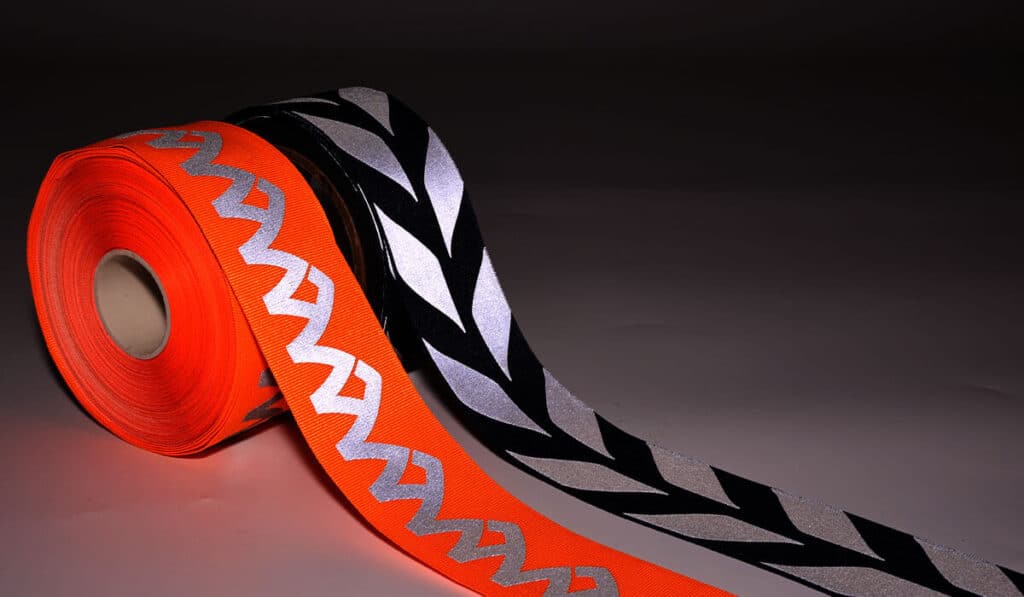
Reflective tape is a surface-marking material that sends light back toward its source. It uses retroreflective tape layers instead of simple gloss. In practical terms, it helps a vehicle, machine edge, post, or work zone marker stand out when headlights or directed light hit it.

Unlike mirrors that reflect light at equal angles, retroreflective tape returns light directly toward the source, ensuring visibility for drivers and operators.

Fluorescent tape enhances visibility in daylight, while reflective tape is designed for low-light conditions. Buyers must distinguish between these materials during sourcing to ensure the correct safety application.

In factory and wholesale communication, several names appear for similar products:

  • Reflective tape
  • Retroreflective tape
  • High-visibility tape
  • Safety tape

Ask suppliers what optical construction sits under the top film. That step prevents confusion between true retroreflective tape and decorative, metallic, or fluorescent tapes sold with similar wording — an important distinction when sourcing high visibility tape at scale.

The science of retroreflection

Retroreflection is the optical property that returns light directly back toward its source with minimal spread. It’s what makes reflective tape appear to “glow” under headlights — even though the tape produces no light of its own.

Three types of reflection

  • Diffuse reflection — Rough surfaces scatter light in all directions. Appears dull at distance.
  • Specular (mirror) reflection — Smooth surfaces reflect light at an equal and opposite angle, often away from the driver.
  • Retroreflection — Engineered optics return light to its source, keeping marked surfaces visible to the driver behind the headlights.

Because headlights and driver eyes sit close together, light returned to the source axis appears intensely bright to the observer.

Angles that control performance

Two angles dictate real-world brightness:

  • Entrance angle — The angle at which light strikes the tape. Performance drops as the angle becomes more oblique.
  • Observation angle — The angle between the light source and the observer’s eye. Smaller observation angles yield stronger perceived brightness.

Approach geometry matters. Trailer sides, gate arms, and safety barriers all present different entrance angles, so tape selection should match the expected line of sight.

The coefficient of retroreflection (Rₐ)

Retroreflective performance is quantified as the coefficient of retroreflection (Rₐ), measured in candelas per lux per square meter (cd/lx/m²). Higher Rₐ values mean more light returned toward the driver. This is the single most important spec when comparing grades — and it’s the metric referenced in ASTM D4956 and other standards.

Color and face-film filtering

The face film acts as a color filter. White and silver return the most light at night. Fluorescent yellow-green and orange improve daytime conspicuity but reduce nighttime Rₐ. Always evaluate samples under both sunlight and headlight conditions before committing to bulk orders.

Types of reflective tape: glass bead vs. microprismatic vs. encapsulated lens

Three optical constructions dominate the market. Each maps to specific ASTM D4956 classifications and applications.

Comparison Table

FeatureGlass Bead (Enclosed Lens)Encapsulated LensMicroprismatic
StructureMicroscopic glass spheres in resin binder with reflective backingGlass beads sealed in air pockets under a top filmMolded 3D cube-corner prisms in polymer film
Typical Rₐ (white)50-70 cd/lx/m²250 cd/lx/m²500-1,000+ cd/lx/m²
ASTM D4956 ClassType I (Engineer Grade)Type III (High-Intensity)Type IV / VIII / IX / XI (Diamond Grade, VIP)
Regulatory FitGeneral facility markingDOT-C2 (some products), traffic signageDOT-C2, SOLAS 1974, EN 12899
Durability5-7 years7-10 years10-12 years
FlexibilityHigh; conforms to curvesModerateLower; stiffer film
Relative CostLowMediumHigh
Best UseWarehouse aisles, low-speed markingTraffic signs, mid-range fleetTrailer conspicuity, high-speed roads, marine

Glass Bead Reflective Tape

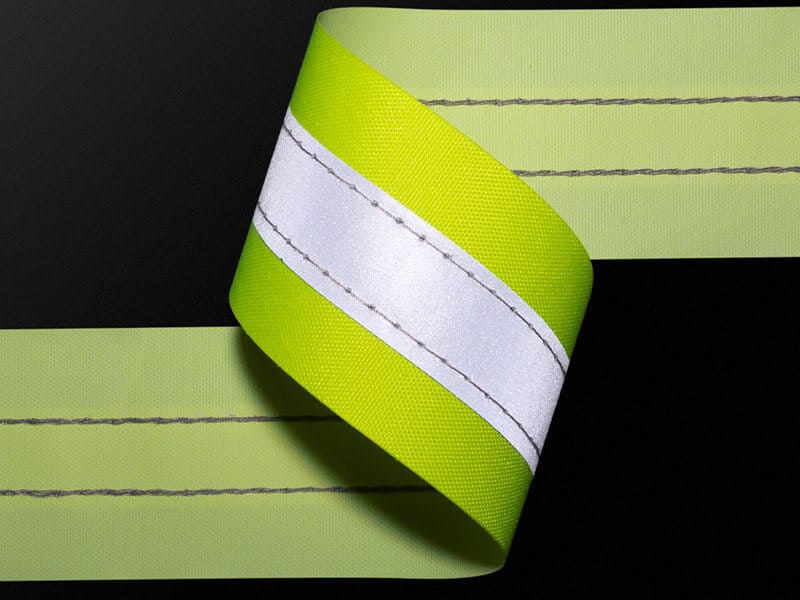
Glass bead tape uses microscopic spheres embedded in a resin binder over a reflective backing. Light refracts through each bead, reflects off the backing, and returns toward the source. It’s flexible, cost-effective, and easy to convert or apply to curved surfaces. Its trade-off is lower peak brightness and faster falloff at distance, which is why it’s typically limited to ASTM D4956 Type I (engineer grade) applications.

Encapsulated Lens Tape

Encapsulated lens tape seals glass beads inside air pockets beneath a smooth top film. This construction improves brightness and weather resistance compared to enclosed-lens glass bead tape and often meets ASTM D4956 Type III (high-intensity) requirements. It’s a common choice for traffic signage and mid-range fleet applications.

Microprismatic Tape

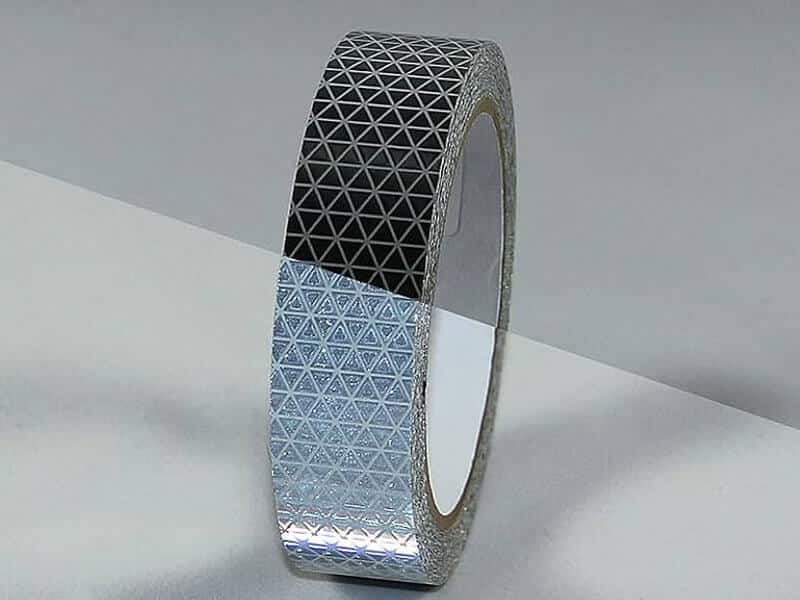
Microprismatic tape replaces spheres with molded cube-corner prisms. Light strikes three internal flat faces and exits nearly parallel to the incoming beam, delivering the highest Rₐ values and the longest detection distances. Diamond-grade microprismatic products meet ASTM D4956 Type IV, VIII, IX, or XI, and are the backbone of DOT-C2 trailer conspicuity kits and SOLAS 1974-approved marine safety marking. Trade-offs: higher cost, stiffer film, and tighter converting tolerances.

Key Industry Standards for Reflective Tape

Compliance is a purchasing filter — not an afterthought. The dominant standards B2B buyers should recognize:

  • ASTM D4956 — U.S. standard classifying retroreflective sheeting by type (I through XI) based on Rₐ, construction, and durability. Type I = engineer grade; Types IV, VIII, IX = high-performance microprismatic.
  • DOT-C2 / FMCSA 49 CFR 393.11 — U.S. Department of Transportation requirement for conspicuity tape on trailers over 80 inches wide and 10,000+ lbs. Requires alternating red/white pattern with certified Rₐ minimums.
  • SOLAS 1974 — International maritime standard requiring retroreflective marking on life-saving appliances (lifejackets, liferafts, lifebuoys).
  • EN 12899-1 — European standard for fixed vertical road signs, referencing retroreflective classes RA1, RA2, and RA3.
  • EN ISO 20471 — High-visibility clothing standard specifying retroreflective performance on PPE.
  • ANSI/ISEA 107 — U.S. high-visibility apparel standard.

Certified tape simplifies audits, supports batch traceability, and reduces liability exposure for distributors, contractors, and OEM buyers.

The Difference Between Reflective and Retroreflective

Factors that affect reflective tape performance

Surface preparation

Reflective tape performs best on clean, dry, smooth substrates. Remove dust, oil, wax, and loose paint before application. Any contamination weakens the adhesive-to-substrate bond, causing edge lift and premature failure.

Application technique

Apply firm, even pressure. Air bubbles and wrinkles create moisture-entry points that compromise adhesion. A premium tape cannot rescue a dirty panel or poor installation.

Environmental exposure

  • UV radiation hardens topcoats and fades face films.
  • Moisture and temperature cycling stress the adhesive layer.
  • Abrasion and impact wear down the reflective face — especially on vehicle edges and loading zones.

Substrate compatibility

Painted metal, powder coating, plastic, glass, and textiles require different adhesive systems. Match adhesive chemistry to substrate to avoid failure well before optical wear-out.

Reflective Tape vs. Other Safety Materials

Material Works Best At Requires Power? Typical Use
Retroreflective tape Night, with directed light No Fleet, PPE, signage
Fluorescent material Day, dawn/dusk, fog No Vests, cones, high-vis apparel
Photoluminescent (glow-in-dark) Total darkness (short duration) No (charged by light) Egress paths, emergency signage
Reflective paint Night, with directed light No Large continuous surfaces
LED lighting Any condition Yes Vehicles, active signage

Reflective tape is a passive fail-safe: no wiring, no batteries, no electrical failure points. Many B2B buyers pair reflective tape with LEDs to maintain visibility even when powered systems fail.

Summarize

Reflective tape is a safety-critical specification, not a commodity purchase. Understanding the optical differences between glass bead, encapsulated lens, and microprismatic constructions — and mapping them to ASTM D4956, DOT-C2, or SOLAS requirements — lets buyers align cost, performance, and compliance from the start.

Review markings on a regular schedule, replace before performance drops below spec, and require certified documentation from suppliers. If visibility is critical to your operation, MAX Reflect can help specify, manufacture, and supply the right reflective tape with OEM/ODM support, wholesale capacity, and practical technical guidance. 

Share:

MAX business

Hot Blogs

how-does-reflective-tape-work

How Does Reflective Tape Work

custom-printed-reflective-tape

Custom Printed Reflective Tape

custom-reflective-gear

Custom Reflective Gear: Sew-On vs. Heat Transfer & The OEM Process

Related blogs

ansi-hi-vis-standard

ANSI Hi-Vis Standard

The ANSI (American National Standards Institute) Hi-Vis Standard provides guidelines for the design and performance of high-visibility apparel, ensuring workers are easily seen in environments with low visibility
reflective-ribbon-tape-process-iron-on-and-sew-on

Reflective ribbon tape process: iron on and sew on

Let’s break down how these tapes are made and the two primary application methods: iron-on and sew-on.
the-difference-between-fluorescent-and-retroreflective

The Difference Between Fluorescent and Retroreflective

In this blog, we’ll break down two key players in visibility technology: fluorescent and retroreflective materials.
high-visibility-safety-apparel

High-Visibility Safety Apparel

This blog dives into the science, standards, and trends behind high-visibility safety apparel (HVSA)—and how our solutions keep your team safe without compromising on style.

Related products

sewn-on-300d-oxford-reflective-warning-tape

Sewn on 300D Oxford reflective warning tape

Sewn-on 300D Oxford reflective warning tape features a premium combination of silver/grey reflective fabric and durable 300D Oxford cloth to enhance visibility and safety in any environment.
reflective-ribbon-tape-stitched

Reflective ribbon tape stitched

Reflective ribbon tape stitched is made of 100% polyester or polyester-cotton blend fabric, which is durable and meets basic safety standards.
pattern-silver-reflective-heat-transfer-webbing-warning-tape

Pattern silver reflective heat transfer webbing warning tape

Combining safety and style, Pattern silver reflective heat transfer webbing warning tape is a premium solution that combines versatility and durability.
iron-on-reflective-ribbon-warning-tape

Iron-on reflective ribbon warning tape

Iron-on reflective ribbon warning tape comes in bright colors such as fluorescent yellow, orange, red, black and pink, and is available in custom sizes.
high-vis-iron-on-oxford-reflective-fabric-tape

High-vis iron-on Oxford reflective fabric tape

Enhance safety with the high-vis iron-on Oxford reflective fabric tape, designed for superior visibility, durability, and versatility.
elastic-reflective-warning-tape

Elastic reflective warning tape

Our elastic reflective warning tape combines premium reflective heat transfer vinyl with elasticated woven tape for a versatile, durable, and comfortable solution.
100%-knitted-fabric-reflective-warning-tape

1005% Knitted fabric reflective warning tape

Elevate safety and style with our 1005% Knitted Fabric Reflective Warning Tape, designed for versatile use in clothing applications.

Send Your Inquiry Now