Feature: Exploring the craftsmanship and quality behind reflective warning webbing

Home » Feature: Exploring the Craftsmanship and Quality Behind Reflective Warning Webbing

In the era of Industry 4.0, AI algorithms can optimize processes, and precision machinery can execute commands. However, they can never fully replace the dexterous hands and keen eyes on the production line. The tension of the substrate needs to be adjusted by touch; microscopic defects require experience to judge—this is the true human touch of manufacturing.

In this chapter, we return to the manufacturer’s perspective to analyze the seemingly simple “reflective warning webbing.” Whether you are a purchaser, a designer, or simply a curious explorer, we welcome you to join us in discovering how a small strip of webbing can bear the dual mission of retroreflective performance and lamination fastness.

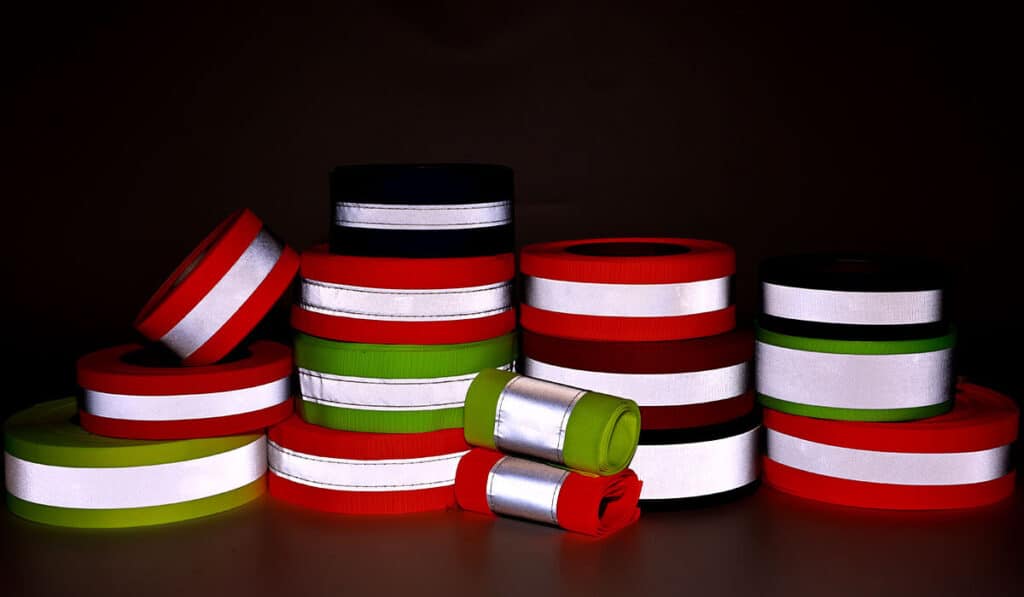
On our product page, these “safety guardians,” formed by combining high refractive index glass beads or microprismatic reflective materials with various webbings, exhibit vastly different retroreflective coefficients (R’), wash fastness, and price points depending on the application scenario and design preferences. Below, we will demystify this topic from three dimensions: material selection, equipment adaptation, and quality control systems.

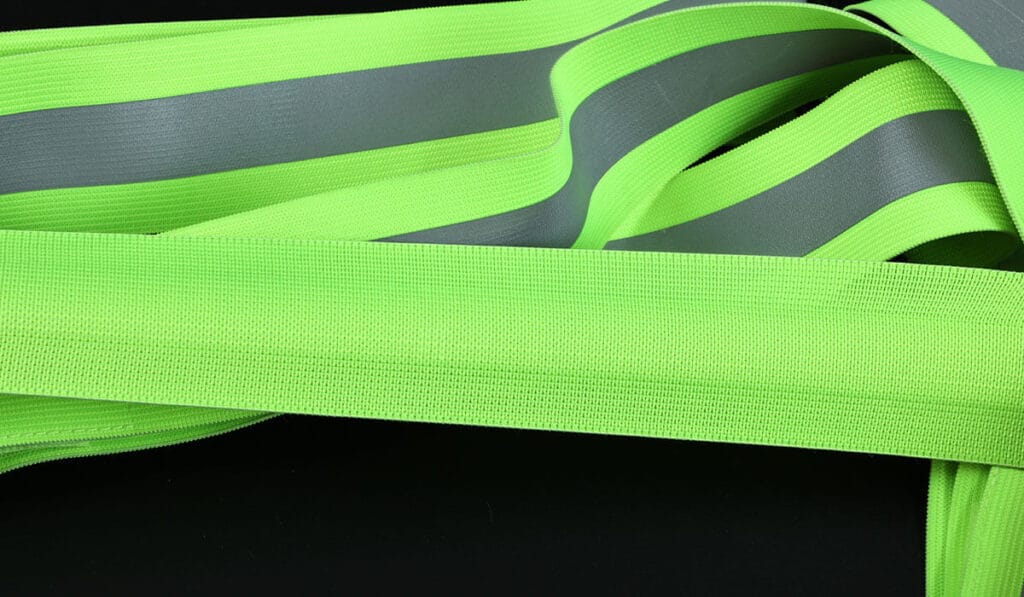
These “DIY-nature” warning belts primarily utilize two core processing methods: precision sewing and heat transfer.

exploring-the-craftsmanship-and-quality-behind-reflective-warning-webbing

Main material: reflective tape - the "first line of defense" for sewn safety

Reflective tape is the soul of the product. Its quality control must be addressed from two dimensions: washing precision and optical performance.
dimensional-accuracy

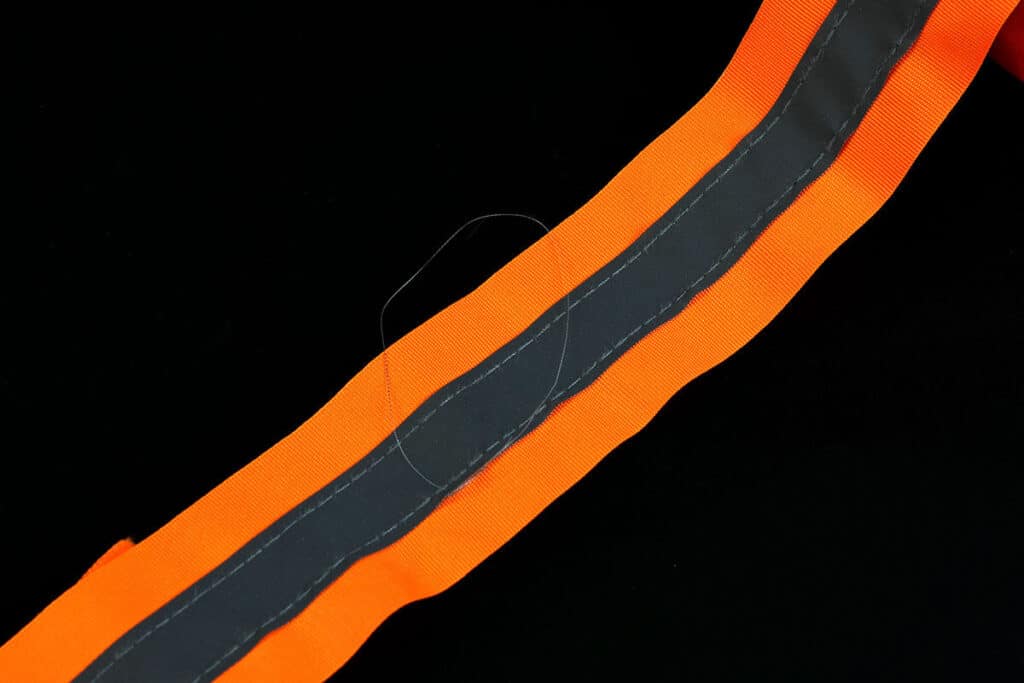
1. Dimensional accuracy

Edge treatment: Is the slit edge smooth and free of fuzz? This directly affects aesthetics during sewing and whether the product edge will fray or experience yarn spillage after multiple washes, according to standards such as EN ISO 20471 or ISO 6330, thereby impacting its lifespan.

Dimensional tolerance: During rotary die cutting, fluctuations in equipment tension can cause width deviations. Our internal standard is to control the error within ±2mm. Anything exceeding this range is classified as a second-quality product.

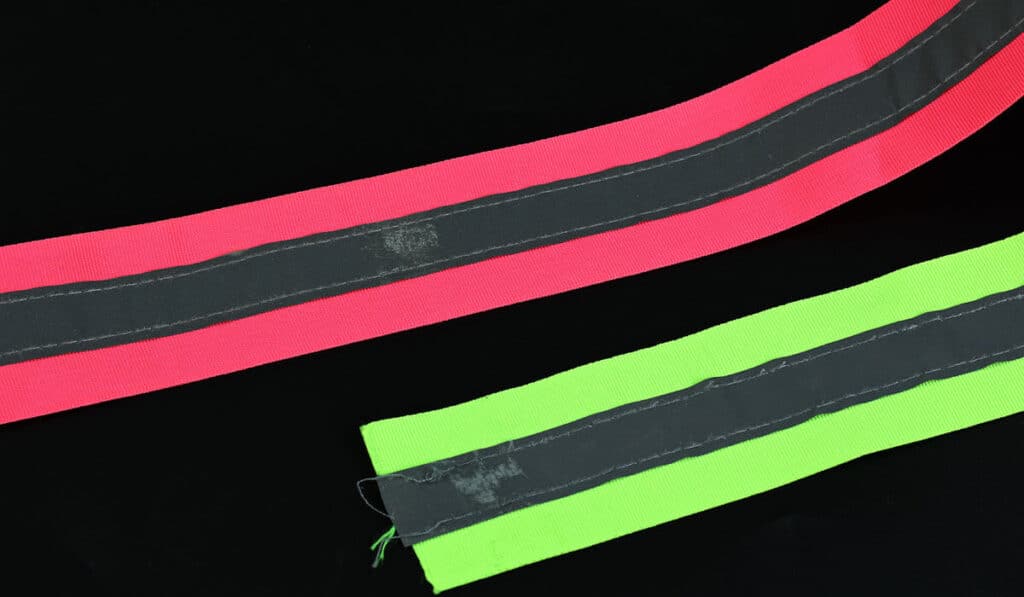
2. Appearance

Surface Cleanliness: Whether silver, grey, or colorful reflective fabric, the surface must be flat and smooth. Any black spots, scratches, or embedded foreign matter are unacceptable. They not only affect appearance but also create localized shading points, destroying the uniformity of the coefficient of retroreflected luminance (RA).

surface-cleanliness

3. Core Performance

Wash fastness: This is key to distinguishing between industrial wash grade and ordinary home washing grade. Standard requirements often mandate compliance with EN ISO 20471 and EN ISO 6330 (4N or 6N). Industrial workwear washing may even require the stringent conditions of ISO 15797 (75°C industrial washing). Behind different prices often lies a significant difference in the glass bead shedding rate. Therefore, we rely not only on supplier certification data but also conduct batch-by-batch spot checks using professional washing shrinkage testers.

Material retroreflectivity: Ranging from a basic R’=20 cd/lx/m² to bright silver R’=620 cd/lx/m², the luminosity span is vast. To ensure nighttime visibility distance, we must use a portable retroreflectometer to perform multi-point tests under standard conditions of a 12′ observation angle and 5° entrance angle, ensuring the CV value (Coefficient of Variation) of the luminosity is controlled within a reasonable range.

Specialty properties: For special working environments like firefighting or welding, we must also consider the material’s flame retardancy (UL94 V-0 rating), solvent resistance, and abrasion resistance (Taber abrasion test) to ensure reliability in extreme conditions.

material-retroreflectivity
wash-fastness

Reflective heat transfer film/vinyl - The "interface engineer" for lamination fastness
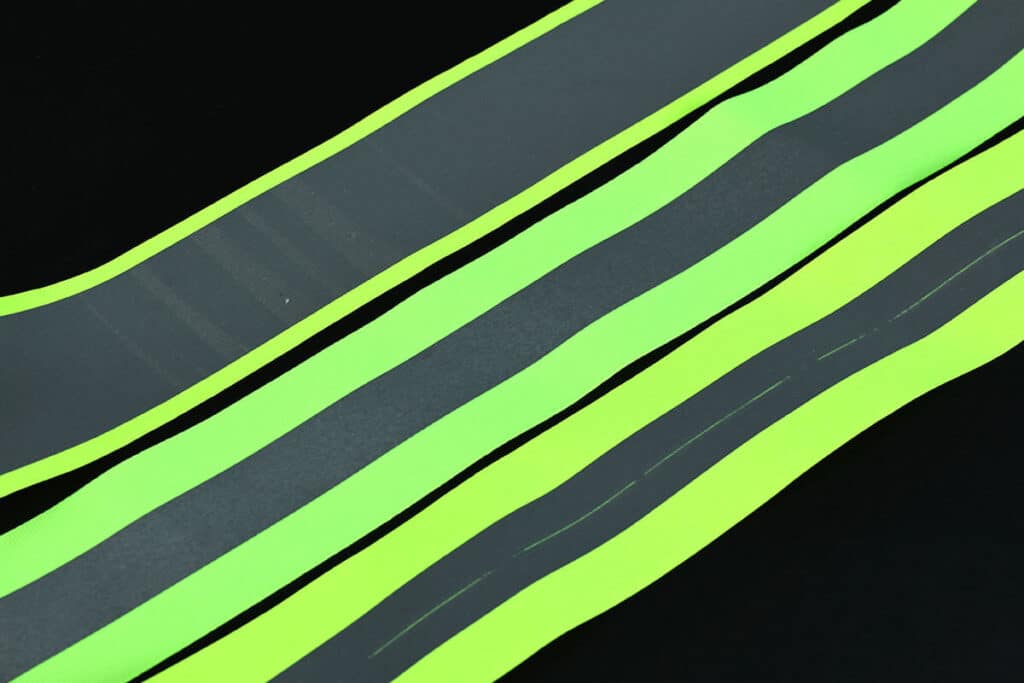
If the sewn-on reflective tape is responsible for optical performance, then the heat transfer film is responsible for interfacial bonding force and the two-way synergy between optics and adhesion. Its selection is not one-size-fits-all but a precise surface energy match.

  • Matching principle: The substrate material (e.g., polyester, nylon), weaving density, and elasticity determine the need to match hot melt adhesive films (e.g., TPU, PA, PES) with different melting points and Melt Flow Indexes (MFI).
  • Quality risks: Improper selection or errors in controlling the laminating temperature curve can, in mild cases, lead to insufficient peel strength after lamination. In severe cases, it can cause glue bleeding, contaminating the fabric surface, or result in material blistering or an orange peel effect due to thermal shrinkage mismatch, leading to complete batch scrapping.
reflective-heat-transfer-film-solution

Substrate selection: Webbing, Oxford fabric, and elastic webbing — The invisible "skeleton"
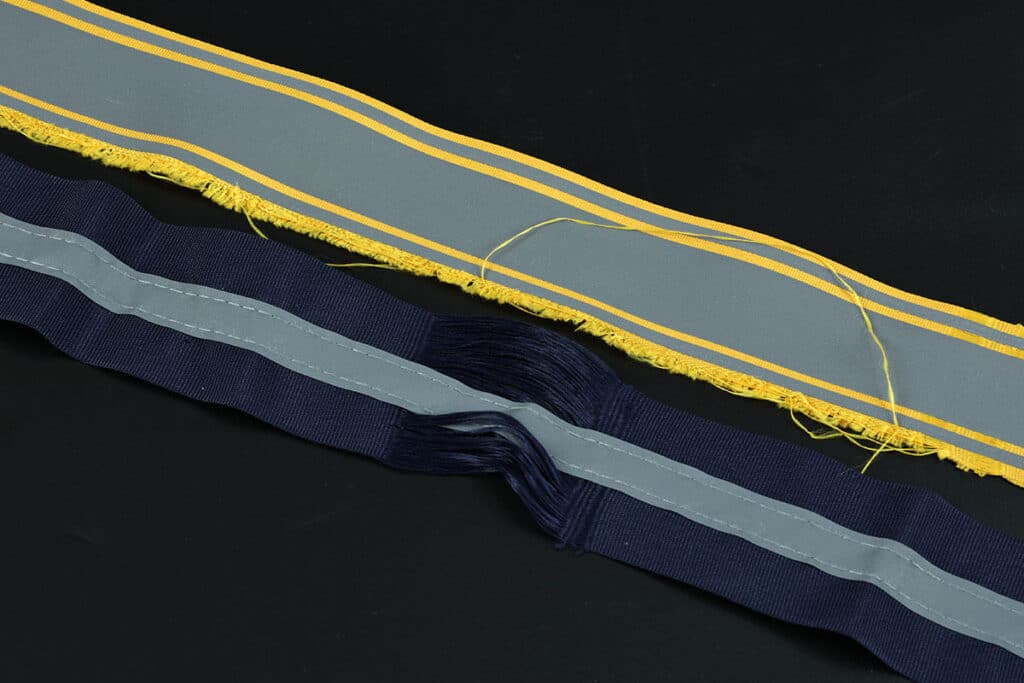
1. Webbing

  • Weight (linear density): Taking 5cm wide webbing as an example, the weight ranges from 5g/m to 20g/m, determining the webbing’s warp and weft density and thickness. Common types are 10g/m or 15g/m. As a key point in IQC (Incoming Quality Control), we allow a weight tolerance of ±0.5-1g, which is an acceptable and controllable range for natural shrinkage during the high-temperature dyeing process.
  • Shrinkage (dimensional stability): The shrinkage rate for ordinary webbing is typically 3%-5%. High-end webbing that has undergone pre-shrinking or heat setting can be consistently controlled below 3%, or even close to 1%.

Before the heat transfer process, we subject the webbing to secondary heat pre-shrinkage using a heat laminating machine. This seemingly “extra effort” further releases internal stress to ensure flatness and guarantees that the final product will not deform or curl during the customer’s subsequent washing or ironing, preventing complaints.

2. Oxford fabric

Specifications and finishing: The most commonly used are lightweight 150D and durable 300D.

Functional coating: The back is typically treated with a PU (Polyurethane) or PVC coating, imparting excellent hydrostatic resistance, abrasion resistance, and tear strength to the Oxford fabric. For outdoor applications like rainwear and tents, the hydrostatic head rating often reaches 3000mm H₂O or more, ensuring dryness in heavy rain.

oxford-fabric

3. Elastic webbing (elastic band) — when "rigid light" meets "flexible force"

If webbing provides stable support, then elastic webbing imparts ultimate conformity and comfort. However, in reflective material processing, elastic webbing is precisely one of the substrates with the highest technical threshold and the most prone to issues. This is a contest between “rigidity” and “flexibility.”

  • Characteristics: High Elasticity is a Double-Edged Sword
    High-quality elastic webbing must possess: high elastic recovery (snaps back quickly after stretching), excellent fatigue resistance, high tensile strength, and a soft, comfortable hand feel.
  • Process difficulty: Elastic Matching is the Core Challenge
    When this “living,” elastic substrate meets the reflective heat transfer film acting as the “rigid functional layer,” the biggest challenge is: Can the hot-melt adhesive layer of the transfer film keep up with the substrate’s expansion and contraction?
  • Risk of delamination: If the elongation at break of the adhesive film is less than that of the substrate, the adhesive layer cannot stretch synchronously during extension. Shear force instantly concentrates at the interface, causing the reflective layer to peel from the substrate.
  • Hand feels deterioration: If the Temperature, Pressure, Time (TPO) of the heat transfer process or the adhesive type is chosen incorrectly, the high temperature and pressure can damage the spandex filaments, leading to an increase in the product’s modulus. It loses its desired softness and becomes stiff and board-like.
  • Our solution: Full-Process Matching Testing
    For this reason, we treat elastic webbing as a dynamic system, not a static fabric. Before each batch of elastic webbing enters the heat transfer process, it must undergo rigorous suitability validation. Only then do we proceed with batch production heat transfer. This step, though seemingly meticulous, provides the most solid guarantee for the customer’s yield rate.
elastic-webbing

Related products

reflective-ribbon-tape-stitched

Reflective ribbon tape stitched

pattern-silver-reflective-heat-transfer-webbing-warning-tape

Pattern silver reflective heat transfer webbing warning tape

sewn-on-300d-oxford-reflective-warning-tape

Sewn on 300D Oxford reflective warning tape

Related information
reflective-ribbon-tape-vs-other-reflective-materials

Reflective Ribbon Tape vs. Other Reflective Materials

reflective-ribbon-tape-process-iron-on-and-sew-on

Reflective ribbon tape process: iron on and sew on
the-difference-between-hi-vis-and-reflective-materials

The difference between Hi-Vis and reflective materials

Get in Touch

Response within 24 hours.

Customised reflective ribbon tape for every Need-MAX

The world of reflective materials is a combination of microscopic precision and macroscopic safety. Every trimmed frayed edge, every luminosity test, every degree of temperature control during lamination speaks to a factory's understanding of the word "safety."

Send Your Inquiry Now